The Data Room Problem: Why Document Management Still Slows Deals
Virtual data rooms are the mechanism, not the problem. The problem is the document infrastructure behind them - disorganized indices that don't match how buyers conduct diligence, documents that exist in multiple versions without clear currency, sections that are densely populated in some areas and empty in others, and completeness gaps that surface as RFI requests rather than being resolved before buyer access is granted. This article examines why virtual data rooms become document graveyards, where the operational friction actually accumulates during diligence, and what deal-ready document infrastructure looks like when it is maintained as an ongoing asset rather than assembled under exit pressure.

.png)
The standard narrative about virtual data rooms is that they solved the document management problem in M&A. Before VDRs, deal teams flew to physical locations to review documents in supervised rooms. The digitization of that process removed the logistical barrier and, in theory, made diligence faster, more concurrent, and more efficient. The technology delivered on those promises. The document management problem did not go away.
Most deal professionals who have spent time on the buyer side of a diligence process have navigated a virtual data room that looked organized in the index and proved chaotic under examination. Folders that promised financial detail contained outdated versions mixed with current ones, with no consistent naming convention to tell them apart. The legal section had the articles of incorporation but was missing the key customer contracts that the buyer's counsel had specifically requested. The technology section had the architecture diagram but not the vendor agreements the technical team needed to assess dependency risk. The operations section was whoever assembled the room's best reconstruction of what operations looked like rather than a current, accurate picture.
These are not technology problems. The VDR performed exactly as designed. The problem is the document infrastructure behind it - what went in, how it was organized, and whether the completeness had been verified before the first buyer received access. The VDR is the vehicle. The document infrastructure is the cargo. And in most exit processes, the cargo was assembled under time pressure, without a governing standard, by a team that was simultaneously managing the business and preparing for a transaction.
This article examines why data rooms become document graveyards, where the operational friction accumulates during diligence, and what deal-ready document infrastructure actually looks like when it is maintained as an ongoing operational asset rather than built from scratch each time a process begins.
Why the VDR Becomes a Document Graveyard
The structural reason most virtual data rooms underperform is that they are treated as a pre-exit project rather than as a continuous operational capability. The decision to prepare a data room typically comes three to six months before an anticipated process launch. The management team and advisors identify the categories of information a buyer will request, locate the documents that exist, and upload what they can find. What they cannot find quickly either gets deferred, approximated with something similar, or becomes a gap that the buyer discovers during diligence.
This assembly-under-pressure model has predictable failure modes. Documents that exist in multiple versions across shared drives, email chains, and individual laptops get uploaded in whatever version is found first rather than the current authoritative version. The folder structure reflects the company's own internal organization rather than the categories a buyer's due diligence team will work through. Sections that are easy to populate - the financial statements the CFO can pull immediately, the corporate filings that are publicly available - get populated first and look comprehensive. Sections that require active work to compile - the complete contract portfolio, the IP registration schedule, the current organizational charts, the updated board minutes - get deferred until the gaps are obvious.
The result is a data room that creates a false confidence during the preparation phase and then generates a wave of requests for information (RFIs) during the actual diligence process. Each RFI adds a round trip to the timeline - the buyer identifies the gap, the seller's team locates or creates the missing document, the document is uploaded, the buyer's team reviews it, and if it generates further questions, the cycle repeats. In a competitive process with multiple bidders, that cycle runs in parallel across several work streams simultaneously. The cumulative delay is not one missed document; it is the aggregate friction of every preparation shortcut the seller took before the process began.
Where Document Friction Actually Accumulates
Four categories of data room dysfunction account for the majority of diligence friction in most deal processes. Each is traceable to a preparation decision made before the buyer received access.
Index Architecture That Does Not Match Buyer Inquiry Patterns
The most common structural failure in a data room is an index that reflects the seller's internal organization rather than the buyer's diligence workflow. A company that organizes its files by department uploads a room organized by department. The buyer's team, working through a standard due diligence checklist organized by function - financial, legal, commercial, operational, technical, regulatory - has to map the company's department-based structure onto their functional framework, guessing which department holds the documents they need and raising RFIs when the mapping fails.
The index architecture problem is compounded in multi-bidder processes where different buyers may be running different work streams simultaneously. A buyer's financial advisor is looking for documents in a different location than the buyer's legal counsel, who is looking in a different location than the technical due diligence team. A well-structured virtual data room anticipates these different inquiry patterns and organises its index so that each team can navigate directly to what it needs. A poorly structured room generates index-navigation questions that consume advisor time and extend the process for reasons that have nothing to do with the complexity of the business.
Document Currency and Version Control
Version control is the failure mode that most consistently erodes buyer confidence once diligence is underway. A buyer who discovers that the financial model in the data room has a different revenue number than the management presentation already reviewed has a reasonable question about which is authoritative. A buyer who finds two versions of the same customer contract without clear indication of which is executed and which is a draft has a reasonable question about the company's legal organization. A buyer who finds that the organizational chart in the data room does not match the leadership team listed in the management presentation has a reasonable question about what else may not be current.
Each of these version control failures is individually minor. Collectively, they produce a signal that the company's document management practices are not well-governed, which is a signal that extends beyond the transaction. Buyers who are acquiring a business want to understand what they are acquiring. A room with poor version control tells them that the company has not maintained a clear picture of its own operating state - and that finding has implications for the post-close integration work, the inherited contracts, and the accuracy of the representations and warranties the seller will make at closing.
Completeness Gaps That Surface Under Diligence
The completeness problem is distinct from the organization problem. A well-organized data room with material gaps is still a slow diligence process. The gaps that matter most are the ones that affect the buyer's ability to form a view on the key value and risk dimensions of the transaction - the customer concentration and contract terms that determine revenue quality, the employment agreements and benefit liabilities that determine people transition risk, the IP registrations and licensing agreements that determine technology asset security, and the regulatory compliance records that determine operating licence risk.
These documents are not lost; they exist somewhere in the company's operational history. But they are often distributed across the legal team's files, the HR system, the CFO's records, and the contracts management process in ways that make assembly non-trivial under deal pressure. The company that has maintained a continuously updated document repository through the hold period arrives at the exit process knowing exactly where these documents are, in their current versions, because the document infrastructure was treated as an operational asset rather than a pre-exit project.
The Expanding Regulatory Documentation Requirement
The scope of what buyers expect in a virtual data room has expanded materially in the past several years as regulatory and governance documentation has moved from a supplementary category to a primary one. The SEC's 2023 cybersecurity disclosure rules - which require public companies to disclose material cybersecurity incidents and annually report on cybersecurity risk management and board governance - have directly shaped what sophisticated buyers now scrutinise during M&A diligence. Buyers evaluating an acquisition target in 2025 routinely request board-level cybersecurity oversight documentation, incident history, and risk management program evidence as standard data room content. Companies that have not produced this documentation as part of their ordinary governance practice face a reconstruction task at exactly the wrong moment in the deal timeline.
For transactions subject to HSR premerger notification requirements, the FTC's premerger notification program creates a specific document production obligation that makes data room readiness a legal timeline factor as well as an operational one. The HSR process requires production of 4(c) documents - ordinary course analyses that discuss the competitive effects of the transaction, including board presentations, strategic analyses, and market assessments - within defined response windows. Companies that have not maintained organized records of their board-level strategic documentation face a document location exercise that is difficult to compress under regulatory deadline pressure. A data room built with regulatory document production in mind is a material advantage when the HSR clock is running.
What Deal-Ready Document Infrastructure Actually Looks Like
The phrase "deal-ready" is used frequently in the M&A advisory context and rarely defined with enough operational specificity to be useful. Deal-ready document infrastructure has three characteristics that distinguish it from a pre-exit assembly exercise.
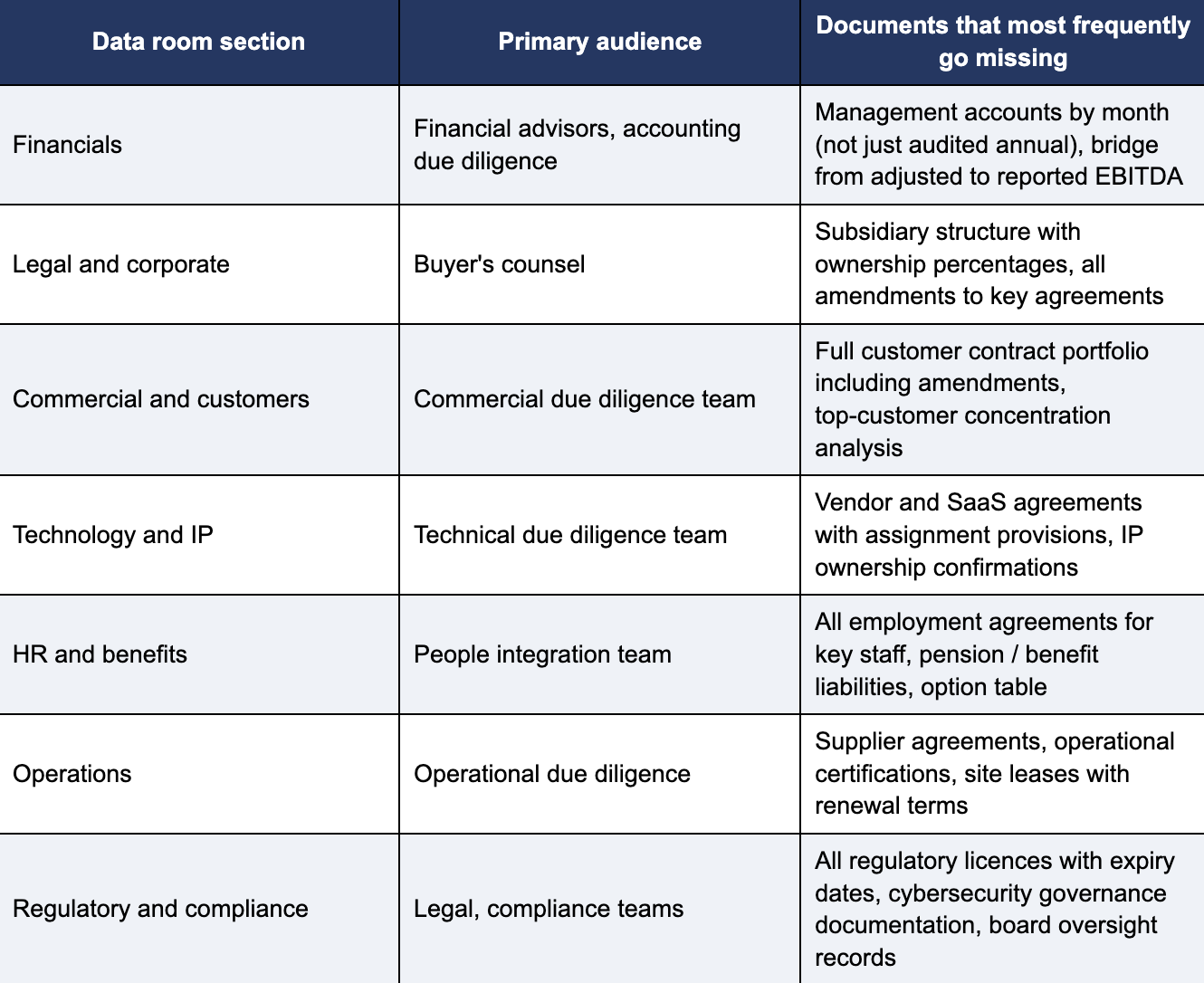
The first is a buyer-perspective index. The folder structure is built around how buyers conduct diligence, not around how the company organizes its own files. The top-level categories align with the standard due diligence work streams - financial, legal and corporate, commercial and customers, operations, technology and IP, HR and benefits, regulatory and compliance. Within each category, the sub-folder structure anticipates the specific documents that each work stream team will look for, named and organized in a way that allows direct navigation without requiring interpretation. This structure is established before population begins and maintained as documents are added over time.
The second is a completeness baseline. A deal-ready virtual data room has been reviewed against an explicit completeness checklist before buyer access is granted - a checklist that maps to what a sophisticated buyer's advisors will request rather than to what the seller found easy to populate. The completeness review identifies the gaps and either resolves them before launch or flags them for proactive disclosure with context, rather than leaving them to be discovered as RFI requests mid-process. The difference between a seller who proactively explains why a document does not exist and a seller whose absence is discovered by the buyer is the difference between controlled disclosure and loss of narrative.
The third is a living document practice. The most important characteristic of deal-ready document infrastructure is that it is maintained continuously rather than assembled at exit. Documents are added to the repository as they are executed, renewed, or updated during the ordinary course of business. Version control is applied as a standard practice rather than as an exit preparation exercise. Board materials, strategic analyses, and governance documentation are organized within the repository rather than distributed across individual laptops and shared drive folders. When the exit process begins, the data room is a current reflection of the business rather than a reconstruction of what the business looked like before the deal pressure began.
This is the structural difference between the data rooms that accelerate processes and the ones that slow them. The technology platform is often identical. The preparation behind it is not.
The following illustrates how a buyer-perspective index maps the categories that deal teams work through:
The Data Room as an Ongoing Operational Asset
The exit-sprint model of data room preparation - assemble everything six months before the process, organize it as best you can, and respond to RFIs as they come - is rational given the constraints most management teams face. Running a business while preparing for a transaction is demanding, and document preparation competes directly with operating priorities. But the exit-sprint model has a compounding cost that becomes visible only when the RFIs start arriving.
The alternative is to treat the data room as a component of the firm's operational infrastructure - an asset that is maintained continuously and updated as the business evolves rather than built from scratch when a process is imminent. This reframing changes the economics of data room preparation substantially. The incremental cost of maintaining current documents in a well-organized repository during the ordinary course of business is low compared to the cost of assembling and completing a disorganized room under deal pressure. The incremental benefit - in process speed, buyer confidence, and narrative control - is high.
For PE-backed companies, this reframing also aligns data room discipline with the value creation plan. The documents that matter most in a buyer's diligence - the evidence of revenue quality, margin improvement, operational efficiency gains, and management depth - are the same documents that the operating partner uses to track value creation through the hold period. A company that has maintained the data infrastructure to support the operating partner's quarterly review has also maintained the data infrastructure that a buyer needs to form a confident view of the business. The two requirements are not separate workstreams; they are the same underlying need served at different moments in the hold period.
How Haptiq Supports Deal-Ready Document Infrastructure
Haptiq's Olympus Deal Management provides the deal-side infrastructure that makes a living document practice sustainable across the hold period. Olympus organizes the deal documentation environment around the buyer-perspective framework rather than the company's own file structure, applies version control as a standard feature rather than a pre-exit exercise, and maintains the completeness baseline that tells both the operating partner and the management team what is current and what needs updating before the exit window opens. For portfolio companies managed through Olympus, the data room is not a project that begins six months before the process - it is a current reflection of the business that is already organized for buyer access when the decision to run a process is made.
For the operational and governance documentation that now forms a significant portion of buyer diligence requirements, Haptiq's Pantheon Digital Transformation works with portfolio company management teams to establish the document management practices that keep regulatory, compliance, and board-level documentation current and accessible. This includes the cybersecurity governance documentation that SEC-influenced buyer diligence now routinely requests, the board-level strategic analysis that HSR production requirements may compel, and the operational certification records that regulatory sections of the data room increasingly need to contain. The Pantheon engagement produces the document management operating model, not just the pre-exit checklist.
Underlying both, Orion provides the operational data layer that connects the portfolio company's live performance data - revenue by customer, margin by product line, operational KPIs by period - to the financial documentation that buyers will need to validate the EBITDA story under diligence. The financial documents in the data room are most credible when the underlying operational data that supports them is organized and accessible. Orion makes that underlying data consistently available, which means the numbers in the room can be traced to their operational source rather than existing as disconnected artifacts of the accounting close.
For further reading on the operational EBITDA levers that the data room documentation needs to support credibly under buyer scrutiny, the Haptiq blog article The Six Operational EBITDA Levers PE Operating Partners Pull First - and the Technology That Makes Them Stick examines what operating partners actually invest in during the hold period to build the EBITDA case that the exit process will depend on. The documents in the data room are the evidence of that investment - and their organization and completeness determines how credibly the story lands under buyer scrutiny.
From Document Graveyard to Deal Asset
The virtual data room is one of the most examined operational tools in M&A, and one of the most consistently underinvested ones. The technology is mature, the standard categories are well understood, and the importance of data room quality to deal timeline and buyer confidence is widely acknowledged. And yet most exit processes still run into the same pattern: a data room that looked ready at launch and proved incomplete under diligence, generating rounds of RFIs that each added time and uncertainty to the process.
The reason is not the technology. It is the document infrastructure behind the technology, and the practice of treating data room preparation as an exit-phase project rather than as a continuous operational discipline. Companies that maintain a living document repository - organized around buyer inquiry patterns, governed by version control, updated as a standard operational practice - arrive at exit processes differently than companies that assemble their data room in the months before launch. They spend less time responding to RFIs and more time on the analytical conversations that move a process toward a close. They control the narrative rather than responding to gaps the buyer has discovered. And they present a picture of operational discipline that extends beyond the documents themselves to the quality of the business behind them.
If your portfolio company's exit preparation depends on assembling a virtual data room in the months before a process launches, the preparation is starting later than it should. Contact Haptiq to scope what a living document infrastructure would look like for your portfolio company - and what the difference between a deal-ready data room and an exit-sprint assembly actually means for process speed, buyer confidence, and the quality of the outcome.
Frequently Asked Questions
1. Why do virtual data rooms slow down deals even when the technology is good?
Because the technology organizes what the seller puts into it, and most sellers put in whatever they can find rather than what the buyer actually needs. A virtual data room is only as useful as the document preparation behind it. When that preparation is incomplete, disorganized, or rushed, the buyer spends diligence time sending RFI requests rather than forming a view. Each round of RFIs adds time to the process, and in a competitive process with multiple bidders, that cumulative friction is measured in weeks rather than days.
2. What is a 'document graveyard' in the context of a virtual data room?
A document graveyard is a virtual data room populated without a governing logic. It typically has a folder structure that reflects how the company organizes its own files rather than how a buyer conducts diligence. It contains documents in multiple versions without clear identification of which is current. It has sections populated densely in some areas and missing key items in others. And it has been assembled under deal pressure rather than maintained as an ongoing operational asset. Buyers navigating a document graveyard spend more time interpreting what is there and escalating about what is missing than forming views about the business.
3. What should a deal-ready virtual data room look like?
A deal-ready virtual data room is structured around how buyers conduct diligence - with an index organized by the standard functional work streams (financial, legal, commercial, operations, technology and IP, HR, regulatory) rather than around the company's internal file structure. Within each section, documents are current, consistently named, and complete enough to answer the anticipated questions without requiring follow-up requests. The data room has been reviewed against a completeness checklist before the first buyer receives access, and gaps have been either resolved or proactively disclosed rather than left to be discovered.
4. How does document preparation affect deal timeline?
Directly and materially. Buyers who receive a well-organized, complete virtual data room can form a preliminary view of the business faster and with fewer clarification requests. Buyers who receive a disorganized or incomplete room send RFIs and wait for responses rather than progressing toward a decision. Each round adds days to the process. For transactions subject to HSR review, document production delays can extend the regulatory timeline in ways that are difficult to recover from without extending the overall deal schedule. The cumulative impact of poor data room preparation is typically measured in weeks of deal timeline lost.
5. When should a company start building its virtual data room?
At least twelve to eighteen months before an anticipated exit process, and ideally as an ongoing operational practice rather than a pre-exit project. The documents that matter most in diligence - financial records, customer contracts, employment agreements, IP registrations, compliance certifications, board minutes - are produced continuously during the ordinary course of business. A company that maintains a living document infrastructure throughout the hold period arrives at the exit process with a virtual data room that reflects the actual state of the business rather than the best reconstruction that deal pressure allows.







.png)

.png)
.png)









.png)





.png)



.png)
.png)



.svg)
.png)


.png)
.png)
.png)


.png)









.png)










.png)








.png)