How RPA and Intelligent Automation Differ and Why It Matters for Your Business
RPA automates repetitive tasks like data entry, while Intelligent Automation (IA) uses AI to tackle complex challenges. Discover their differences, real-world uses, and how Haptiq blends both to boost efficiency and growth for your business.


Robotic Process Automation (RPA) and Intelligent Automation (IA) are two of the most consequential technologies reshaping how modern businesses operate. Both eliminate manual effort from processes that humans once handled by hand—think data entry, invoice processing, compliance reporting—but they differ significantly in scope, capability, and the kind of value they create.
If you're evaluating where to invest in automation, understanding the distinction between RPA vs intelligent automation isn't just a technical exercise. It's a strategic decision that shapes your operating model, your cost structure, and your ability to compete.
This article breaks down exactly how the two differ, where each one fits, and how to think about combining them—with practical examples drawn from private equity, manufacturing, life sciences, logistics, and financial services.
Understanding robotic process automation (RPA)
Robotic Process Automation uses software robots—commonly called "bots"—to replicate the actions a human would take when interacting with digital systems. These bots can log into applications, copy data between systems, fill out forms, generate reports, and execute rule-based decisions without any human involvement.
Think of RPA as a highly reliable digital worker that never sleeps, never makes typos, and never gets distracted. It's particularly powerful when the work is predictable, structured, and high-volume.
What makes RPA tick?
RPA thrives in environments where tasks are well-defined and consistent. The processes best suited to RPA share a few common characteristics:
- Repetitive: Executed frequently with little or no variation—daily report generation, monthly data pulls, recurring compliance checks.
- Rule-based: Governed by clear, programmable logic. If X happens, do Y. No ambiguity required.
- Structured: Dependent on organized, standardized data—spreadsheets, forms, databases, or fixed-format documents.
- Low-complexity: Free of nuanced judgment, contextual interpretation, or creative decision-making.
The payoff of RPA
The business case for RPA is straightforward and well-proven. Organizations that deploy it typically see:
- Cost reduction: Bots operate 24/7 without fatigue, dramatically reducing the labor cost of high-volume transactional work.
- Accuracy gains: Human error—typos, missed fields, copy-paste mistakes—disappears. This matters enormously in compliance-sensitive environments.
- Scalability: Bots can be replicated and deployed across multiple systems with minimal incremental cost.
- Workforce reallocation: When bots handle the routine, your people can focus on judgment-intensive, customer-facing, or strategic work.
Haptiq's intelligent automation capabilities include RPA as a foundational layer—deployed through partnerships with enterprise-grade platforms like Blue Prism and Automation Anywhere, and integrated directly into your existing tech stack with minimal disruption.
Exploring intelligent automation (IA)
Intelligent Automation takes everything RPA does and layers in artificial intelligence. Where RPA follows scripts, IA reasons. Where RPA needs structured inputs, IA can interpret unstructured data. Where RPA executes fixed rules, IA adapts to changing conditions.
IA combines RPA's execution capabilities with technologies like machine learning (ML), natural language processing (NLP), optical character recognition (OCR), computer vision, and predictive analytics. The result is a system that doesn't just perform tasks—it understands context, learns from outcomes, and improves over time.
Where IA shines
IA is purpose-built for processes that go beyond simple repetition. It's the right tool when:
- Complexity is high: Workflows span multiple systems, require cross-functional coordination, or involve exceptions that don't fit a standard template.
- Data is unstructured: Emails, PDFs, handwritten notes, call transcripts, social media—IA can extract meaning from all of it.
- Conditions change dynamically: Fraud patterns evolve, demand signals shift, customer behavior varies. IA adapts where RPA would break.
- Decisions carry strategic weight: Personalizing customer offers, flagging compliance risks, predicting supply chain disruptions—these require intelligence, not just automation.
A practical example: imagine an IA system scanning hundreds of invoices arriving in different formats from different vendors. It extracts the relevant fields, cross-references them against purchase orders and payment records, flags discrepancies, and routes exceptions for human review—all without predefined templates or manual intervention. That's IA operating at its best.
Why IA stands out
The advantages of intelligent automation extend well beyond efficiency:
- Predictive insight: IA analyzes historical and real-time data to forecast outcomes—customer churn, equipment failure, demand spikes, compliance gaps—before they become problems.
- Flexibility across data types: Unlike RPA, IA doesn't require clean, structured inputs. It handles messy, diverse, and unstructured data natively.
- Continuous learning: IA systems improve with every interaction. Feedback loops refine model accuracy, making the system smarter over time.
- Decision velocity: By automating complex judgment calls at scale, IA compresses the time between insight and action—a critical advantage in fast-moving markets.
- Strategic value creation: IA doesn't just reduce cost. It surfaces opportunities, improves customer experience, and enables operating models that weren't previously possible.
Haptiq's Pantheon framework embeds cognitive automation directly into enterprise systems, ensuring that IA deployments are scalable, governed, and aligned with your broader operational architecture.
RPA vs intelligent automation: key differences
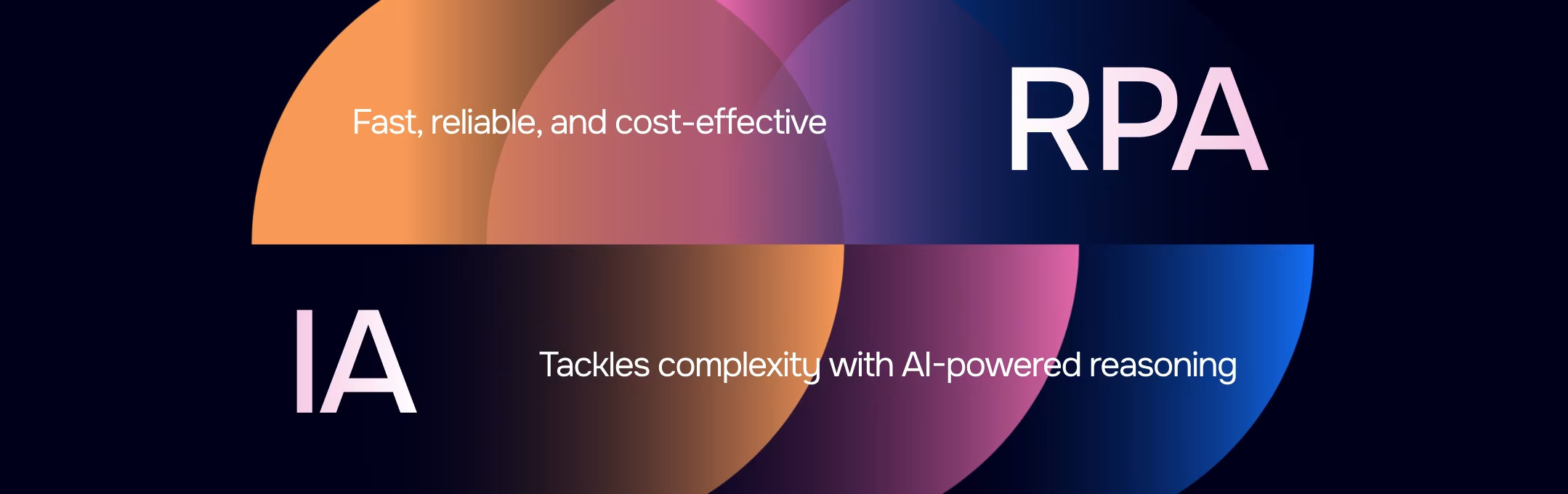
The simplest way to frame the distinction: RPA executes; IA reasons.
RPA is a workhorse—fast, reliable, and cost-effective for structured, rule-based work. IA is a thinker—capable of interpreting ambiguity, learning from data, and making context-aware decisions. RPA logs customer orders into a CRM. IA analyzes those orders, detects sentiment patterns, identifies upsell opportunities, and recommends next-best actions—all in one pass.
Quick comparison snapshot

Real-world examples
Private equity portfolio management: RPA automates the monthly collection of standardized financial data from portfolio companies—saving hours of manual aggregation. IA goes further, scanning unstructured earnings call transcripts, identifying sentiment shifts, flagging performance risks, and surfacing anomalies that warrant attention before the next board meeting.
Customer service operations: RPA routes incoming support tickets based on keyword matching. IA reads the full content of each ticket, interprets customer intent, prioritizes urgent cases based on predicted churn risk, and drafts personalized responses—reducing resolution time and improving satisfaction scores.
Life sciences and manufacturing: RPA automates batch record entry and compliance documentation. IA monitors real-time production telemetry, detects deviations before they escalate into quality events, and triggers governed workflows for CAPA initiation—turning reactive compliance into proactive quality management.
Logistics and transportation: RPA processes shipment confirmations and updates tracking records. IA orchestrates dynamic rerouting decisions when delays cascade, predicts capacity constraints before they materialize, and coordinates responses across carriers, warehouses, and customers in real time.
Complementary, not competing
Here's the key insight that often gets lost in the RPA vs intelligent automation debate: these technologies aren't rivals. They're designed to work together.
RPA handles the execution layer—the high-volume, structured, repeatable work that forms the operational backbone of most enterprises. IA handles the intelligence layer—the interpretation, prediction, and adaptive decision-making that turns data into strategic advantage. Together, they create an automation ecosystem where routine work runs on autopilot and complex decisions are informed by machine intelligence.
Hybrid approaches that combine both are now the standard for organizations serious about operational excellence. Haptiq's end-to-end automation practice is built around exactly this model—designing automation architectures that deploy RPA where it delivers the fastest ROI and IA where it creates the deepest strategic value.
Choosing the right fit for your business
Use RPA when the work is stable, rule-based, and high-volume. Bring in IA when the data is messy, the decisions are complex, or the process needs to adapt to changing conditions. In most enterprise environments, the answer is a thoughtful combination of both.
Here's a practical framework for making that call:
Step 1: audit your workflows
Start by mapping your processes. Identify which tasks are repetitive and structured—these are your RPA candidates. Then look for workflows that involve unstructured data, exception handling, or judgment-based decisions—these are where IA creates the most value. Process discovery tools can accelerate this analysis significantly.
Step 2: assess your data maturity
RPA works with whatever data you have today, as long as it's structured. IA requires data that can train and validate models. If your data is fragmented, inconsistent, or siloed, you may need to address data infrastructure before IA can deliver its full potential. Haptiq's Digital Process Baseline assessment helps organizations quantify these gaps before committing to a deployment path.
Step 3: prioritize by impact and readiness
Not every process is worth automating immediately. Focus first on workflows that are high-volume, error-prone, and directly tied to cost or revenue. These deliver the fastest ROI and build organizational confidence in automation as a capability.
Step 4: design for scale from the start
The biggest mistake organizations make is treating automation as a series of isolated projects rather than a scalable operating model. Governance frameworks, reusable components, and integration standards need to be established early—otherwise, you end up with a fragmented collection of bots that's expensive to maintain and impossible to scale.
Mapping your needs
Consider a few industry-specific scenarios:
Retail and e-commerce: RPA automates inventory updates from supplier feeds, keeping stock levels current across channels. IA analyzes demand signals from social media, web traffic, and historical sales patterns to dynamically adjust reorder points and prevent stockouts before they happen.
Financial services: RPA processes loan applications by pulling credit scores and populating decision templates. IA assesses the full applicant profile—including unstructured data from application emails and supporting documents—to surface risk signals that structured data alone would miss.
Private equity operations: RPA standardizes KPI collection across portfolio companies, enabling consistent reporting. IA identifies performance patterns across the portfolio, flags outliers, and surfaces value creation opportunities that manual analysis would take weeks to uncover.
Life sciences: RPA automates batch record entry and regulatory submission formatting. IA monitors production data in real time, detects deviations from GMP parameters, and initiates governed response workflows—compressing the time between detection and corrective action.
Partnering with experts
Haptiq's approach to automation goes well beyond deploying bots. Our consultants begin with a structured discovery and assessment process—analyzing your workflows, systems, and data to identify where automation creates the most value. We then design, prototype, implement, and continuously optimize solutions that integrate seamlessly with your existing architecture.
Our end-to-end consulting model covers:
- Discovery and assessment — Mapping workflows and quantifying automation opportunities
- Solution design and prototyping — Building tailored automation architectures with measurable outcomes
- Implementation and integration — Deploying with minimal disruption and full system connectivity
- Testing and optimization — Refining automated processes to maximize performance
- Ongoing support and enhancement — Continuously evolving automation as your business grows
We don't just automate processes—we build the operating infrastructure that makes automation a durable competitive advantage.
Is RPA still relevant in 2026?
Absolutely. RPA remains one of the highest-ROI automation investments available to enterprise organizations. The technology has matured significantly, and modern RPA platforms now integrate natively with AI capabilities — including generative and agentic AI — blurring the line between traditional RPA and intelligent automation in practice.
What's changed is the context. RPA is no longer the ceiling of what automation can achieve — it's the foundation. Organizations that have already deployed RPA are now layering agentic AI on top to unlock the next tier of value: moving from automating individual tasks to orchestrating end-to-end workflows that plan, adapt, and execute autonomously. Organizations that haven't started yet have the advantage of designing their automation architecture with all three layers in mind from day one.
The question in 2026 isn't whether to use RPA. It's how to position RPA within a broader intelligent automation strategy — one that connects task-level automation to enterprise-wide orchestration and scales with your business.
Conclusion on transforming your business with Haptiq
RPA and intelligent automation represent two distinct but complementary paths to operational excellence. RPA delivers speed, precision, and cost reduction for structured, repetitive work. IA brings adaptability, intelligence, and strategic depth to complex, judgment-intensive processes. Together, they form the backbone of a modern, AI-native operating model.
The organizations winning today aren't choosing between RPA and IA—they're deploying both, thoughtfully, within a governance framework designed to scale. At Haptiq, that's exactly what we help our clients build: automation strategies that don't just reduce cost, but create measurable operational lift, compress decision cycles, and expand EBITDA.
Ready to map your automation opportunity? Explore Haptiq's intelligent automation solutions or connect with our team to start the conversation.
FAQ section
Q1: How does RPA differ from intelligent automation in functionality?
RPA automates repetitive, rule-based tasks using predefined scripts—think data entry, form filling, or report generation. Intelligent automation (IA) uses AI technologies like machine learning and NLP to handle complex, unstructured data and make context-aware decisions. RPA is fast and reliable for structured work; IA adds the reasoning layer that enables adaptive, judgment-intensive automation. Most enterprise deployments benefit from combining both.
Q2: Can RPA and IA be used together effectively?
Yes—and in most mature automation programs, they are. RPA handles the execution layer: high-volume, structured, repeatable tasks that run on autopilot. IA handles the intelligence layer: interpreting unstructured data, predicting outcomes, and adapting to changing conditions. Together, they create a seamless automation ecosystem that delivers both operational efficiency and strategic insight. Haptiq designs hybrid architectures that deploy each technology where it creates the most value.
Q3: What industries benefit most from RPA and intelligent automation?
Virtually every industry with high-volume transactional work or complex data environments can benefit. The highest-impact use cases tend to appear in:
- Private equity and financial services — Portfolio reporting, compliance monitoring, risk analysis
- Manufacturing — Production monitoring, quality management, workforce coordination
- Life sciences — GMP compliance, batch record management, deviation response
- Logistics and transportation — Shipment tracking, exception management, dynamic rerouting
- Retail and e-commerce — Inventory management, demand forecasting, order orchestration
- Utilities and energy — Outage management, grid operations, field workforce coordination
Haptiq's automation practice spans all of these sectors, with purpose-built playbooks for each.
Q4: Is RPA still relevant in 2026?
Yes. RPA remains one of the most proven and cost-effective automation investments available. Modern RPA platforms have evolved to integrate natively with AI capabilities, making them a natural foundation for intelligent automation programs. The shift in 2026 is less about whether to use RPA and more about how to position it within a broader AI-native operating model. Organizations that treat RPA as the foundation—and layer IA on top—are seeing the strongest compounding returns on their automation investments.
Q5: How do I decide which tasks are right for RPA vs intelligent automation?
A practical rule of thumb:
- Choose RPA when the task is repetitive, the data is structured, the rules are clear, and the process rarely changes.
- Choose IA when the data is unstructured, the decisions require judgment, the process involves exceptions, or the environment changes frequently.
- Combine both when you need high-volume execution (RPA) informed by intelligent analysis (IA)—which describes most enterprise automation opportunities.
If you're unsure where to start, a structured process audit is the fastest way to identify your highest-value automation candidates.
Q6: How do I choose where to start with automation?
Four steps that consistently work:
- Audit your workflows — Map your processes and identify which are repetitive and structured vs. complex and variable.
- Assess your data maturity — Determine whether your data is clean and accessible enough to support AI-driven automation.
- Prioritize by impact — Focus first on high-volume, error-prone processes directly tied to cost or revenue.
- Design for scale — Establish governance frameworks and integration standards before deploying, so your automation program can grow without accumulating technical debt.
Haptiq's discovery and assessment process is designed to move you through these steps quickly, with clear recommendations and measurable expected outcomes.








.png)


.png)

.png)
.png)








.png)





.png)



.png)
.png)



.svg)
.png)

.png)
.png)
.png)


.png)









.png)









.png)








.png)