Why Most Post-Merger Integrations Stall After Day 100
Post merger integration rarely fails in the first wave of planning and cutovers. It stalls when execution becomes routine, ownership blurs, and workflow coordination is not treated as an operating system. This article explains why Day 100 is the inflection point, how decision latency and hidden friction erode momentum, and how sponsors can govern integration as continuous execution rather than a finite project.

Post merger integration is often judged by what happens early: whether leadership aligns, whether the integration management office is staffed, whether the first system cutovers land, and whether the combined organization avoids visible disruption. Those early milestones matter, but they are not where integrations typically lose their economic case. The stall comes later, after the initial surge of attention fades and the combined organization moves from planned activity to day-to-day execution.
Day 100, roughly the point where the first three months of post-close intensity have passed, is where post merger integration becomes most vulnerable. The integration program still exists on paper, but operational ownership starts to blur. Teams return to local priorities. Exceptions and edge cases multiply. Decisions slow down because context is fragmented across systems and business units. Governance becomes meeting-heavy but outcome-light. What looked like a coordinated program begins to behave like a set of loosely related initiatives.
This article examines why post merger integration momentum commonly fades after Day 100, why unresolved workflow coordination and decision rights create hidden friction, and how sustained value creation requires managing execution long after systems are “integrated.” The goal is not to add process for its own sake. The goal is to treat integration as an operating discipline that keeps decisions fast, responsibilities clear, and outcomes measurable through the full value creation window.
Key Takeaways
- The Day 100 Inflection Point: Integration momentum typically fades after the first 90 days as focus shifts from high-level milestones to complex operational execution.
- Workflow Debt: Stalls are caused by "workflow debt"—the accumulation of manual workarounds and fragmented decision rights that turn scale into complexity.
- Workflow Contracts: To sustain value, organizations must define "workflow contracts" that specify triggers, decision authority, and completion criteria for core value streams.
- Comparability Over Perfection: Standardizing KPI definitions across entities is more critical for governance than immediate, full-scale system consolidation.
- Speed-Based Governance: Effective post-merger governance should be measured by the reduction of decision latency rather than the volume of meetings.
Why Day 100 is the inflection point in post merger integration
In the first 30 to 60 days, integration work benefits from structural advantages. Leadership attention is concentrated. Decision-making forums exist and are well attended. Teams tolerate ambiguity because the objective is stabilization. People accept temporary workarounds because the program is visibly progressing. The integration management office can “push” outcomes through the organization because escalation paths still work.
By Day 100, those advantages weaken. Most teams assume the hard part is done because the most visible milestones are complete: organizational announcements, first system integrations, branding decisions, initial procurement harmonization, and early reporting consolidation. Yet the work that converts the deal thesis into durable operational performance typically lives in the operational middle: how work actually moves across functions, systems, and entities when reality is variable.
Post merger integration stalls at Day 100 because the organization is no longer operating in a special mode. It is operating in the new normal. If the new normal still relies on manual coordination, unclear decision rights, and inconsistent exception handling, the integration tax becomes permanent. Value creation does not fail loudly. It fails quietly, through delays, rework, leakage, and the slow return of local habits.
The hidden mechanics that cause post merger integration to stall
When integration teams diagnose a stall, they often point to symptoms: “culture issues,” “change fatigue,” “system complexity,” or “lack of accountability.” Those are real, but they are rarely the root cause. The root cause is usually operational: execution is still fragmented, so the combined company cannot make and implement decisions quickly enough to converge on a single operating reality.
Five mechanics show up repeatedly in post merger integration stalls after Day 100.
Decision rights remain implicit, so approvals become bottlenecks
Most organizations believe they have clear decision rights, until they integrate. Integration forces decisions that were previously local to become cross-entity: how orders are prioritized, how credit is approved, how inventory is allocated, how customer commitments are made, and how exceptions are resolved.
When decision rights are not explicit, approvals become habit-driven. Work waits for the “right person” rather than moving through a defined authority model. The result is decision latency: the time between a decision trigger and the decision being made. Decision latency is the enemy of sustained post merger integration because it drives backlog growth, customer dissatisfaction, and internal friction even when teams are capable.
The operational middle remains fragmented across systems
Even when the organization has a target architecture, most post merger integration programs live for months or years in a multi-system reality. Enterprise resource planning (ERP) systems remain separate. Customer relationship management (CRM) systems differ by region. Warehouse management systems (WMS) and transportation management systems (TMS) vary by site. Ticketing tools and shared inboxes proliferate.
The stall occurs when teams treat this as a temporary inconvenience rather than an execution design problem. Multi-system environments can work, but only if workflows, data definitions, and decision logic are standardized enough that work can move end-to-end without constant translation.
Exceptions become the primary workload, but are managed informally
During early integration, teams focus on “happy path” process alignment: standardize procurement steps, unify invoice layouts, align reporting hierarchies. After Day 100, the majority of operational effort shifts to exceptions: invoice mismatches, service escalations, fulfillment disruptions, credit disputes, supplier nonconformance, and integration-related customer churn risk.
If exceptions are managed through email threads and informal escalation, the combined company never stabilizes. Post merger integration becomes a permanent triage operation, and the integration program loses credibility because people experience the combined organization as slower and more frustrating than before.
Metrics are consolidated, but they are not comparable
Many integration scorecards look sophisticated: consolidated revenue, consolidated procurement spend, consolidated headcount. The problem is that operational definitions remain inconsistent. “On-time delivery” may mean departure in one entity and arrival in another. “Cycle time” may be measured from different start and stop events. “Cost-to-serve” may be allocated differently across business units.
When KPIs are not comparable, governance becomes a debate. Sponsors and executives spend time reconciling definitions instead of driving execution. Post merger integration needs comparability early, not perfection, because comparability is what enables accountability.
Integration debt accumulates in workflows, not in project plans
Integration debt is often described as technical debt, but the most expensive form is workflow debt: the accumulation of manual handoffs, duplicated checks, parallel approvals, and exception loops that grow because the organization never replaces the old operating behaviors with a new, unified execution model.
Workflow debt compounds. Every acquisition adds more variants. Over time, the organization becomes harder to run, even if it becomes larger. This is why post merger integration stalls are so damaging: they turn scale into complexity rather than into leverage.
What “sustained integration” actually means after Day 100
Sustained post merger integration is not an extension of the Day 1 plan. It is a different posture. Early integration is about stabilization and sequencing. Sustained integration is about execution convergence: making the combined company operate as one system in the workflows that drive customer outcomes, compliance posture, and financial performance.
A useful definition is this: post merger integration is sustained when work moves from trigger to outcome across entities with predictable ownership, governed decision points, and measurable completion criteria.
That definition highlights what most integration programs miss. Sustained integration is not a set of projects. It is an operating model.
The operating model that keeps post merger integration moving
Post merger integration after Day 100 needs a lightweight but disciplined operating model that does three things: keeps decision rights explicit, keeps workflows coordinated across systems, and keeps performance measurable in comparable terms. The model does not require more committees. It requires clearer execution assets.
Establish a workflow contract for the value streams that matter
A workflow contract is a shared definition of how work moves through a value stream, including its decision points, exceptions, and completion criteria. It is not a detailed standard operating procedure. It is a state-based model that answers:
- Where does the work start, and what event triggers it?
- What states must the work move through before it is “done”?
- Which decisions are required, and who has authority at each decision point?
- What evidence is required to move forward, and what constitutes completion?
- What exceptions are expected, and how are they routed and escalated?
In post merger integration, workflow contracts are most valuable when applied to recurring value streams such as order-to-cash, procure-to-pay, and service operations. These are the areas where small delays become systemic because they touch many teams and many customers.
Convert decision rights into managed decision assets
Decision rights cannot remain tribal. They must become explicit, versioned decision assets that can be reviewed, updated, and reused. In practical terms, this means separating decision logic from individual tools and from individuals’ institutional knowledge.
Examples include credit approval thresholds, discount approval rules, customer prioritization logic during constrained supply, and escalation rules for service level agreement (SLA) breaches. When decision logic becomes a managed asset, integration can adapt without re-litigating authority every time conditions change.
Treat exceptions as first-class process states, not edge cases
Most integration stalls are exception stalls. The solution is not to eliminate exceptions. The solution is to manage them as normal process states with consistent classification, routing, and evidence requirements.
That shift changes execution economics. Instead of exceptions consuming unlimited management attention, exceptions become measurable work with ownership and resolution paths. Post merger integration stops being a perpetual escalation loop and becomes an execution system.
Standardize comparability before standardizing systems
System consolidation is a long-term objective in many post merger integration programs, but comparability should be an early objective. Executives and sponsors can tolerate heterogeneity if they can see performance consistently and drive accountability.
This requires standardized KPI definitions tied to process events, not tied to local reporting conventions. It also requires consistent timing boundaries so that cycle time, backlog aging, and service performance mean the same thing across entities. Comparability is what makes post merger integration governable after Day 100.
Where to focus first: the value streams that most often stall
Not every integration workstream needs the same level of operational design. The best targets share three traits: high exception rates, measurable cycle time, and cross-functional coordination overhead. In most post merger integration programs, three domains show up as repeatable bottlenecks.
Order-to-cash: where integration friction becomes cash friction
Order-to-cash performance is often impaired after acquisitions because billing processes differ, customer terms differ, dispute categories differ, and ownership is split between sales, finance, and operations. Teams may consolidate invoicing systems eventually, but the immediate stall is operational: disputes bounce, approvals slow, and collections prioritization becomes inconsistent.
A sustained post merger integration approach focuses on dispute intake standardization, evidence assembly, routed ownership, and governed approval thresholds for credits and write-offs. The sponsor-grade outcomes are clear: reduced dispute cycle time, reduced backlog aging, and faster cash realization.
Procure-to-pay: where scale benefits disappear without workflow convergence
Procure-to-pay stalls often appear as “supplier onboarding delays” or “invoice exception backlogs,” but the root is usually inconsistent policy enforcement across entities. Approval chains differ. Matching logic differs. Spend categories are coded differently. The organization attempts shared services, but shared services inherits the variability rather than eliminating it.
Post merger integration holds together when supplier onboarding and invoice exceptions are managed through a unified workflow contract: completeness checks, consistent exception classification, routed resolution, and evidence-captured approvals. The goal is not perfection. The goal is throughput with control.
Service operations: where customers experience integration first
Customers feel integration through service. If case routing becomes inconsistent, entitlement logic differs by acquired product lines, or resolution requires coordination across systems, customers experience the combined company as less responsive. That creates churn risk even if the integration plan looks fine on paper.
Sustained post merger integration requires standardized intake and escalation behaviors, with flexibility for specialized resolution work. The objective is to standardize how work enters the system and how it is governed, while allowing local expertise to resolve complex issues.
Governance that protects speed rather than slowing it down
After Day 100, many organizations respond to stalls by adding more governance layers. That often slows decisions further. The better approach is to define governance that protects speed with control.
Two widely used references can help structure this posture. The Committee of Sponsoring Organizations of the Treadway Commission (COSO) Enterprise Risk Management framework emphasizes aligning risk ownership and control activities with business objectives, rather than treating controls as separate from execution. Similarly, ISO 31000 provides practical guidance for integrating risk management into organizational processes so that risk is managed within day-to-day decision-making, not after the fact.
For post merger integration, the practical translation is straightforward.
Define authority levels by decision type
Not every decision needs the same control posture. Create explicit authority levels such as:
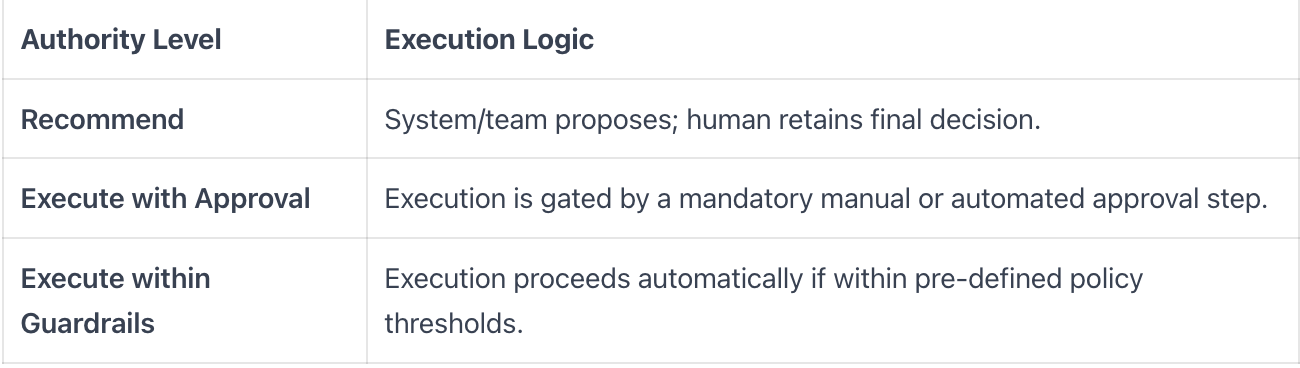
This model reduces ambiguity while avoiding blanket approval requirements that create bottlenecks.
Make segregation of duties explicit
Segregation of duties (SoD) is often discussed in finance, but it also matters operationally when workflows span multiple entities. In post merger integration, SoD breaks when teams share access to multiple systems without consistent controls or when approvals become informal to “keep things moving.”
SoD should be designed into the workflow contract: who can initiate, who can approve, who can execute, and what evidence is required. This keeps post merger integration defensible, especially in regulated industries or public-company contexts.
Measure governance by outcome, not by meeting volume
If governance does not reduce decision latency, it is not working. Leaders should track approval latency, exception backlog aging, and rework rates as governance KPIs. These measures reveal whether the organization is getting faster and more consistent, which is the real purpose of governance after Day 100.
A practical playbook for sustaining post merger integration beyond Day 100
Sustained integration becomes manageable when the organization treats execution assets as deliverables, not just project milestones. A pragmatic approach usually looks like this.
Days 0 to 30: stabilize and define the first workflow contract
The goal is continuity and clarity. Pick one or two value streams where breakdown would be immediately visible, and define the workflow contract at a state level. Document decision rights and escalation rules. Establish baseline metrics for cycle time, approval latency, backlog aging, and error rates.
Days 30 to 100: standardize exception handling and comparability
Most integration drag is exception drag. Build consistent exception classifications and routed resolution paths. Align approval thresholds. Establish comparability for the chosen value streams so that leadership can see performance without definition debates.
Beyond Day 100: institutionalize and scale patterns
This is where post merger integration either compounds or stalls. Turn the workflow contracts, decision assets, and KPI definitions into reusable patterns. Expand them across additional entities, add-ons, or regions. Replace informal escalation with systematic exception management. Track performance drivers continuously so the organization can adapt without reintroducing fragmentation.
For a deeper perspective on why integration success depends on the execution layer, Haptiq’s article on AI-driven post merger integration provides a useful operational framing: AI Platforms for Post-Merger Integration: From Roll-Ups to Operational Integration.
How Haptiq helps prevent the Day 100 stall
Post merger integration tends to stall when the combined organization lacks an operating system for cross-entity execution, lacks design and delivery enablement to translate operating intent into durable workflows, and lacks continuous visibility that keeps value creation accountable after the integration management office stops pushing. Haptiq addresses these constraints through a coordinated platform and enablement approach.
Orion supports sustained execution by acting as an operational brain, where work crosses systems and teams. In Day 100 reality, the constraint is often not knowing that decisions are stalling until the backlog becomes visible. The Notifications Hub within Orion keeps execution aligned by delivering intelligent, context-aware alerts across systems, teams, and channels in real time, so exception buildup and approval latency are surfaced early enough to intervene while outcomes are still recoverable:
Pantheon Solutions supports post merger integration by operationalizing the operating model and the delivery plan, not by producing one-off artifacts. The stall after Day 100 often happens because the organization has a target design but lacks the delivery muscle to turn it into repeatable execution assets across entities. Pantheon’s Value Creation offering brings structured design and hands-on delivery that helps translate integration intent into durable workflows, decision assets, and operating rhythms that survive leadership rotation and acquisition cadence.
Olympus supports sponsor and leadership visibility across the full deal lifecycle, which becomes essential when integrations shift from “program mode” to “run mode.” After Day 100, the value creation question is no longer whether the plan exists, but whether execution is still converging and whether the deal thesis needs to be resequenced based on a single source of truth. Olympus Deal Management enables scenario planning and centralized oversight so leadership teams can revisit assumptions, stress-test trade-offs, and keep post merger integration execution tied to measurable value capture rather than to calendar milestones:.
Bringing it all together
Most post merger integration programs do not collapse during the early surge of activity. They stall when integration becomes routine, ownership blurs, and the operational middle is left to manual coordination across fragmented systems. Day 100 is the inflection point because it reveals whether the combined company has an execution model, not just an integration plan.
Sustained post merger integration requires a workflow contract for the value streams that drive outcomes, explicit decision rights treated as managed assets, exception handling designed as normal work, and comparable measurement that keeps governance outcome-driven. When those elements are in place, integration becomes a compounding capability rather than a recurring tax, and each acquisition strengthens operational leverage instead of increasing complexity.
Haptiq enables this transformation by integrating enterprise grade AI frameworks with strong governance and measurable outcomes. To explore how Haptiq’s AI Business Process Optimization Solutions can become the foundation of your digital enterprise, contact us to book a demo.
FAQ
1) Why does post merger integration stall after Day 100 specifically?
Day 100 is typically when the initial integration intensity fades and the organization returns to normal operating rhythms. At that point, unresolved fragmentation in workflows, decision rights, and exception handling becomes visible as delays and rework. The integration management office can no longer “push” outcomes through escalation, so execution depends on whether the combined company has a durable operating model. If decision latency and ownership ambiguity persist, the integration tax becomes structural and value capture slows quietly rather than failing dramatically.
2) What is the difference between “systems integrated” and “operations integrated”?
Systems integrated usually means key applications can exchange data, reporting can be consolidated, and some standardized processes are in place. Operations integrated means work moves end-to-end across teams and entities with consistent ownership, explicit decision points, and predictable closure criteria. Many organizations achieve the first without achieving the second, which is why post merger integration can look complete in project terms while still underperforming operationally. The Day 100 stall is often the moment when this gap becomes undeniable.
3) How do decision rights cause hidden friction in post merger integration?
When decision rights are implicit, approvals default to habit, hierarchy, or whoever is available, which creates inconsistent outcomes and long waiting time. Cross-entity execution then becomes dependent on informal escalation rather than on a defined authority model. This increases approval latency, slows exception resolution, and expands backlogs in value streams like order-to-cash and procure-to-pay. Making decision rights explicit and treating decision logic as a managed asset reduces ambiguity and keeps execution moving without relying on constant leadership intervention.
4) Which workflows should executives prioritize to prevent the integration stall?
Executives should prioritize workflows where exceptions are frequent, cycle time is measurable, and cross-functional coordination is unavoidable. In most environments, order-to-cash, procure-to-pay, and customer-facing service operations meet those criteria and produce sponsor-grade outcomes. These workflows also surface integration failure modes early because they touch customers, suppliers, and cash. By defining workflow contracts, exception classifications, and comparable KPIs for these value streams, leaders prevent drift from becoming a permanent operating condition.
5) How can sponsors measure whether post merger integration is still delivering value after Day 100?
Sponsors should measure drivers that reveal whether execution is converging: cycle time by workflow state, approval latency, exception backlog aging, rework rates, and touchless processing rates where applicable. Those operational measures should then be linked to financial outcomes such as cash conversion, cost-to-serve, leakage from credits and write-offs, and SLA-related revenue risk. The critical requirement is comparability across entities so governance is not consumed by definition disputes. When measurement is consistent, leadership can see whether integration is compounding or stalling and can intervene with targeted workflow changes.





.png)


.png)

.png)
.png)





.png)




.png)


.png)
.png)



.svg)
.png)


.png)
.png)
.png)

.png)





.png)





.png)






.png)