AI Platforms for Post-Merger Integration: From Roll-Ups to Operational Integration
AI platforms for post-merger integration are changing how roll-ups achieve operational consistency by accelerating process, data, and workflow harmonization across newly combined entities. This article explains why integration lag persists, how AI-native orchestration compresses harmonization timelines, and how Haptiq’s ecosystem supports repeatable early-stage execution across portfolios.

Roll-ups create scale on paper quickly. The hardest work begins after close: turning multiple operating realities into one coherent system of execution. In most roll-ups, the integration bottleneck is not deal rationale, leadership alignment, or a synergy spreadsheet. It is the slow, uneven harmonization of processes, systems, data, and workflows across newly combined entities - the operational integration required to deliver consistent outcomes.
This is where ai platforms for post-merger integration are becoming decisive. Traditional post-merger integration (PMI) approaches often rely on manual mapping, spreadsheet-driven governance, and phased system consolidation that takes longer than the value-creation clock allows. AI changes the economics by accelerating the work that consumes time and creates variability: identifying process differences, reconciling data definitions, routing work across entities, and enforcing consistent decision logic in workflows.
The critical point is that integration is not won by visibility alone. Dashboards can show divergence, but they do not fix it. The integration advantage comes from execution - from AI-native orchestration that reduces integration lag by moving work consistently from trigger to outcome across entities from the outset, while capturing evidence and controlling risk.
This article explains how AI platforms for post-merger integration accelerate harmonization, why AI-native orchestration improves operational consistency early in the integration cycle, and how PE sponsors and corporate acquirers can build repeatable integration patterns that compound across acquisitions.
Why roll-ups stall in the operational middle
Most integration plans over-index on endpoints: consolidate ERPs, standardize reporting, centralize procurement, and unify customer experience. Those are valid goals, but they do not address the operational middle - the day-to-day execution layer where orders get fulfilled, invoices get matched, disputes get resolved, and service cases get closed.
Integration stalls in this middle for four reasons:
- Process variance is structural. Each acquired entity has local practices, exception paths, and approval logic that evolved around its systems and constraints.
- System heterogeneity persists. Even with a target architecture, intermediate states can last years. Teams operate across multiple ERPs, CRMs, WMS/TMS, ticketing tools, and spreadsheets.
- Data definitions are inconsistent. “Customer,” “product,” “on-time,” “margin,” and “cycle time” often mean different things in each entity, making KPI roll-ups misleading.
- Workflows do not converge by decree. Shared services and standardized policies fail if the work intake, routing, and evidence requirements remain fragmented.
This is why operational consistency rarely appears quickly after close. Without a unifying execution layer, the combined organization inherits multiple operating systems. Over time, that fragmentation becomes a tax: delayed synergies, uneven customer experience, and governance overhead that scales with complexity rather than volume.
What post-merger harmonization actually requires
Post-merger harmonization is frequently treated as a sequence of IT migrations and org changes. In practice, it is a coordinated redesign of four assets.
Process harmonization
Agreeing on how value streams work end-to-end - not just the happy path, but the exception logic, approvals, and evidence requirements that define real execution.
Systems harmonization
Creating a practical integration posture for the hold period: which systems remain, which become systems of record, and how work flows across tools in the interim state.
Data harmonization
Standardizing entity definitions, reference data, hierarchies, and KPI logic so performance is comparable and decisions are consistent.
Workflow harmonization
Ensuring work actually moves: consistent intake, routing, prioritization, escalation, and closure across entities, with auditable evidence.
AI accelerates integration when it is applied to these harmonization problems as an execution strategy, not as an analytics add-on.
What AI platforms for post-merger integration do differently
The most useful definition of AI platforms for post-merger integration is practical: platforms that compress harmonization time by orchestrating cross-entity execution while making policy, data, and measurement consistent enough to scale.
In roll-ups, AI value is rarely created by a single model. It is created by a set of capabilities working together:
- A workflow spine that coordinates work across entities and systems
- A decision layer that enforces consistent policies and approvals
- A context layer that reconciles data definitions and creates trusted cross-entity views
- Observability that shows where integration is stalling and why
- Governance and auditability that make cross-entity execution defensible
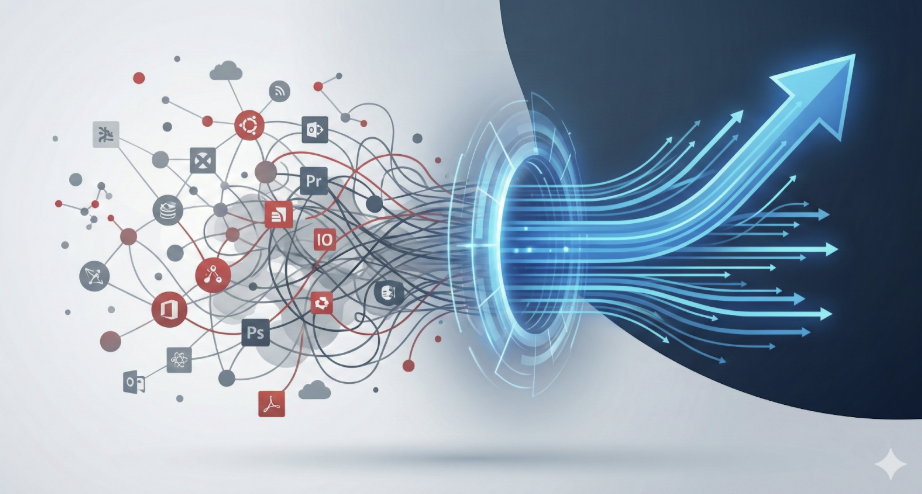
This is also why AI can change the PMI timeline. Instead of waiting for full system consolidation to standardize operations, AI-native orchestration can overlay the environment, standardize workflows, and enforce decision logic across entities while system migration progresses in parallel.
How AI-native orchestration reduces integration lag from the outset
Integration lag is largely composed of waiting and rework: waiting for missing information, waiting for approvals, waiting for downstream teams, and rework caused by inconsistent definitions and incomplete evidence. AI-native orchestration targets these failure modes by shifting PMI from “plan and migrate” to “orchestrate and converge,” creating operational consistency early in the integration cycle.
1) Process harmonization at speed
AI can accelerate the upfront work of understanding process variance and turning it into a practical standard.
Instead of relying on workshops alone, integration teams can map priority value streams at the state level: what “done” means at each step, which exceptions must be handled, and where approvals and evidence are required. The goal is not a perfect global process map. It is a workable process contract: shared boundaries, shared decision points, and shared evidence requirements that can be enforced through workflows.
This matters because the hardest part of roll-ups is not agreeing on the objective. It is agreeing on the operational truth. A state-based approach creates clarity: where the work starts, what must happen before it moves, and what constitutes closure.
2) Systems harmonization without waiting for a big bang
Many roll-ups never reach a single-system end state within the value-creation window. AI platforms for post-merger integration create leverage by treating the interim state as designable, not as a temporary inconvenience.
AI-native orchestration supports a pragmatic posture:
- Keep systems where they are, but standardize how work moves between them
- Integrate through events and APIs where possible
- Use controlled workflow overlays for cross-entity execution
- Migrate systems progressively without freezing operational standardization
This reduces the PMI trade-off between speed and control. Orchestration standardizes execution now, while IT consolidation continues as a longer-term program.
3) Data harmonization that supports comparability
KPI consistency is often the first casualty of roll-ups. If data is not harmonized, then performance governance becomes a debate instead of a discipline.
AI accelerates data harmonization by helping teams reconcile entity definitions across datasets (customers, suppliers, products, terms), establish crosswalks and mappings that align hierarchies, and standardize KPI logic tied to process events rather than local reporting conventions. The goal is not perfect data. The goal is reliable comparability early, when integration risk is highest and executive attention is most limited.
4) Workflow harmonization that actually moves work
The fastest route to operational integration is not rewriting every SOP. It is standardizing workflow behavior:
- How work enters the system
- How it is routed and prioritized
- How approvals occur and what evidence is required
- How exceptions are escalated and resolved
- How closure is verified
This is where AI platforms for post-merger integration create an early advantage: they can implement a consistent workflow contract across entities even when teams and systems remain distributed.
Where AI platforms for post-merger integration create immediate value in roll-ups
Not every PMI workstream benefits equally from AI. The best targets share three traits: measurable cycle time, heavy exception rates, and cross-entity coordination overhead.
Order-to-cash consistency across entities
Disputes, credits, collections prioritization, and invoice accuracy often differ by entity. AI-native orchestration can standardize dispute intake, evidence collection, routing, and approvals across acquired businesses, improving cash consistency and reducing leakage while lowering cross-entity friction.
The operational benefit is not only faster closure. It is fewer “false escalations,” fewer incomplete handoffs, and less rework caused by missing context. The financial benefit is more predictable cash conversion and reduced margin leakage from avoidable credits.
Procure-to-pay control and throughput
Supplier onboarding, policy thresholds, invoice exceptions, and approval chains frequently diverge after roll-ups. A unified workflow pattern can standardize exception handling and evidence capture across entities, enabling shared services scale without introducing control gaps.
This is a common synergy unlock in roll-ups because standardization enables purchasing scale and control, while workflow convergence reduces the backlog dynamics that often follow shared services transitions.
Service operations harmonization
Service case routing, entitlements, escalation logic, and resolution workflows can become fragmented in roll-ups - especially when product lines or regions remain semi-autonomous. Orchestration can standardize intake and escalation behaviors while leaving specialized resolution work local. That is often the right balance: standardize the control surface of service execution without forcing uniform resolution approaches where product complexity differs.
Supply chain exception response
Roll-ups often create duplicate logistics processes and inconsistent allocation rules. AI-native orchestration can standardize exception response workflows - mitigation steps, approvals, customer communications, and verification - improving reliability and reducing “integration noise” that hits customers first.
An early-stage harmonization playbook using AI platforms for post-merger integration
The fastest integration programs treat harmonization as a staged execution rollout, not as a long requirements phase.
Immediately post-close: establish a workflow contract
Focus on a small number of value streams that drive customer experience, cash, and operating control.
- Define 2-3 priority value streams and their state models
- Codify key decision points and evidence requirements
- Stand up cross-entity intake and routing for exceptions, where friction creates the most delay
The immediate post-close goal is not full standardization. It is controlled execution with consistent handoffs and visibility into where work stalls.
First month: standardize exception handling patterns
Most integration drag accumulates in exceptions, not in the happy path. By the end of the first month, the integration team should be converging on consistent exception behaviors.
- Implement reusable exception classifications and resolution paths
- Align approval thresholds and escalation rules
- Begin KPI comparability for the priority value streams
This is where teams often see the first measurable reductions in cycle time and backlog aging, because exceptions stop bouncing between entities without ownership.
First quarter: expand to governance and portfolio comparability
By the first quarter, the objective shifts from “make it work” to “make it repeatable.”
- Extend the workflow patterns across additional entities and teams
- Expand KPI standardization and create an integration scorecard
- Build a reusable integration pattern library for the next acquisition
This is where the compounding advantage emerges. Instead of rebuilding PMI from scratch for every deal, the organization accumulates reusable patterns that accelerate each subsequent integration.
Governance, auditability, and risk in AI-driven PMI
When AI influences workflows, the risk profile changes from informational error to operational exposure. That does not make AI unsuitable for PMI. It makes governance non-negotiable.
A practical control model includes:
- Clear authority levels (recommend, execute with approval, bounded execution)
- Explicit policy assets (thresholds, checks, segregation of duties)
- Audit-ready evidence for actions and approvals
- Exception escalation rules with rationale and context
For a widely adopted structure for AI governance, the NIST AI Risk Management Framework provides a lifecycle view of identifying, measuring, and managing AI risk in deployed systems:
How Haptiq supports AI-native post-merger harmonization
AI platforms for post-merger integration require more than task automation. They require governed context, controlled orchestration, and performance comparability across entities. Haptiq’s ecosystem aligns to these integration needs through three capabilities.
Orion Platform for cross-entity workflow orchestration
Orion Platform provides an AI-native operations spine for orchestrating workflows across systems and entities. In PMI, this enables early workflow contracts, standardized exception routing, and controlled approvals that reduce integration lag while preserving auditability.
Olympus Performance for KPI consistency and integration scorecards
Post-merger execution becomes harder to govern when each entity reports performance differently, using different definitions and timing boundaries. Olympus Performance supports harmonization by standardizing KPI logic and enabling comparable performance views across entities, so integration leaders can track progress through an integration scorecard tied to operational drivers - not just project milestones. That KPI consistency is what turns “integration progress” into measurable operational convergence.
Pantheon AI & Data for governed integration context
In roll-ups, harmonization slows down because workflows and data still live across multiple ERPs, CRMs, and operational tools long after the acquisition. Pantheon System Integration reduces that integration lag by establishing reliable connectivity across systems, so cross-entity workflows can run end-to-end without waiting for full application consolidation. This makes it practical to standardize routing, approvals, and exception handling across newly combined entities while the broader technology roadmap progresses in parallel.
For additional context on why execution systems matter more than isolated automation during operational change, Haptiq’s article Beyond the Data: Why Enterprises Are Moving Towards AI-Native Operations provides a useful perspective.
Bringing it all together
Roll-ups succeed when operational integration keeps pace with deal velocity. The hardest part of PMI is not announcing a new org chart or selecting a future ERP. It is harmonizing how work actually gets done across entities - processes, systems, data, and workflows - while maintaining control and comparability.
This is why ai platforms for post-merger integration are becoming a practical accelerator. By enabling AI-native orchestration, governed decisioning, trusted cross-entity context, and comparable KPI measurement, they reduce integration lag and improve operational consistency from the outset. The compounding advantage comes when integration patterns become reusable assets - accelerating each subsequent acquisition rather than restarting PMI from zero.
Haptiq enables this transformation by integrating enterprise-grade AI frameworks with strong governance and measurable outcomes. To explore how Haptiq’s AI Business Process Optimization Solutions can become the foundation of your digital enterprise, contact us to book a demo.
Frequently Asked Questions
1) What are ai platforms for post-merger integration in practical terms?
AI platforms for post-merger integration are systems that accelerate harmonization by orchestrating cross-entity execution while improving policy consistency and KPI comparability. They help integration teams standardize workflows and exception handling even when underlying systems remain heterogeneous. The value is not only analytics - it is controlled execution from intake to closure across entities. In practice, they reduce integration lag by shrinking waiting time, rework, and handoff friction.
2) Why do roll-ups struggle to achieve early operational consistency after close?
Most roll-ups inherit multiple process versions, data definitions, and system landscapes. Even with strong governance, execution remains fragmented because work still moves through local tools and local approval logic. Early consistency requires a workflow contract - shared states, decision points, and evidence requirements - enforced through orchestration rather than policy memos. AI-native orchestration helps create that contract without waiting for full IT consolidation.
3) How does AI accelerate harmonization without forcing full system consolidation?
AI platforms for post-merger integration can overlay the environment with standardized workflows that coordinate work across existing systems. This allows teams to harmonize intake, routing, approvals, and exception paths while system migration progresses in parallel. The approach reduces dependency on a big-bang system change, which often exceeds the value-creation window. The result is faster execution convergence and fewer operational disruptions.
4) What are the best early use cases for AI in post-merger integration?
The best early use cases are exception-heavy value streams with clear KPIs and cross-entity coordination friction. Order-to-cash disputes, procure-to-pay exceptions, service case routing, and supply chain exception response often produce measurable cycle time gains quickly. These use cases also repeat across acquisitions, making them strong candidates for reusable workflow patterns. Early wins should be tied to outcomes such as throughput improvement, backlog reduction, and KPI consistency.
5) How should teams govern risk when using AI platforms for post-merger integration?
Risk governance starts with explicit authority boundaries: what AI can recommend, what it can execute with approval, and what it can execute within strict guardrails. Policies and thresholds should be treated as managed assets, and every action should be logged with rationale, approvals, and evidence. Human checkpoints should be placed where judgment materially reduces risk, not where tradition adds delay.





.png)

.png)

.png)
.png)





.png)




.png)

.png)
.png)


.svg)
.png)

.png)
.png)
.png)


.png)




.png)





.png)





.png)