Every campus recruitment season, fresh graduates face the same decision: which offer do you take, and why? The company name? The salary? The role?
We asked seven associates who joined Haptiq through the Associate Program — across DevOps, data engineering, software engineering, and data analytics — the questions that actually matter. They had different backgrounds, different offers on the table, and they all said yes to Haptiq.
Here's what they found on the other side.
01 — The decision
Why Haptiq? There were other offers.
Every one of them had options. So why here?
"Joining Haptiq was not just about accepting a job offer — it was about choosing the kind of environment where I believed I could truly grow."
— AdityaParas made his call based on scope. As a fresher, he wanted end-to-end exposure — not to be siloed into one corner of a stack. "I felt that the learning curve here would be much stronger, and that's something I valued more than just the company name."
For Priyansh, it was a moment during the campus drive itself. When Haptiq's team talked about AI's role in the company's future, something clicked. "By the end of the process, I was genuinely hoping I would get the opportunity to join Haptiq."
Krishna noticed something in the hiring process that most companies don't get right: "It felt less like a traditional hiring experience and more like joining a team that actually wanted to help people grow."
The theme across all of them? They weren't chasing a brand name. They were chasing an environment — one where growth would be real.
02 — The reality check
What actually surprised them
Everyone came in with assumptions. Almost all of them were wrong — in the best way.
Aditya expected a slow ramp. Training sessions. Small tasks. Months of observation. "What genuinely surprised me was how quickly the transition from training to real-world projects happened. Within just a few months, we were allocated to actual client projects."
Mayuresh felt the same. "I thought my initial months would mostly involve slowly learning systems, fixing small bugs. What surprised me was how quickly I earned trust to handle meaningful work."
Rishika came braced for the cold reality of corporate life. She found the opposite. "I've found it quite 'pampering' in the best way! The structured support — Udemy-based learning, dedicated mentors monitoring our progress — has been a total gem of an experience."
Priyansh was struck by the mentorship and culture from day one. "Right from the start, the onboarding felt very welcoming. It immediately felt like a place where people were approachable and supportive."
"Instead of being treated like 'just another associate,' I was encouraged to contribute ideas, ask questions, and participate in actual discussions that impacted work."
— KrishnaThe surprise wasn't the workload. It was the trust.
03 — The first real moment
When it stopped feeling like practice
At some point, the work stops feeling like training and starts feeling like something that actually matters.
Shriram felt it working on company-wide access control across Haptiq's entire infrastructure. "Digging deep into those tools and realizing they could handle complexities I never thought possible made me realize I was working on a truly impressive level of technology."
For Paras, it was simpler and just as powerful: "Seeing my code go through reviews, deployments, and then become part of a production system — that was the moment where it truly felt real."
"That's when everything started connecting for me — understanding how raw data, transformations, models, and reports all come together to create actual business impact."
— PriyanshMayuresh found his moment on a brand new project — migrating to a CMS the company had never used before, for a live client. "It was no longer about practicing concepts or building demo projects. The work we were doing would directly impact a live production application."
Aditya captured the feeling precisely: "I realized that my contribution genuinely mattered — this work would be used by real users."
04 — When things got hard
The hard moments — and what came after
Real work means real problems. We didn't ask for the highlight reel. We asked for the hard moments.
Shriram's team hit a wall mid-deployment — pivoting repeatedly under pressure to get it right. "It was a high-pressure situation, but it became a masterclass for me. Now, I can do the same work in a fraction of the time it originally took."
Priyansh spent months onboarding a complex financial entity — multiple data sources, fiscal year differences, report requirements that had to match exactly. "Since the reports directly impacted business visibility for the client, even small mismatches in numbers had to be analyzed very carefully." They got it done.
"Difficult problems become manageable when the team collaborates effectively and stays curious enough to keep exploring solutions."
— MayureshAditya put it plainly: "Strong teams are not defined by projects that go smoothly — they are defined by how they respond when things become challenging."
The pattern across every story: nobody faced it alone.
05 — The confidence shift
From new person to team member
Shriram described it as gradual — until his teammates started coming to him as the go-to person. "Becoming an integral resource for the team made me realize I wasn't just 'the new person' anymore — I belonged here."
Krishna noticed the shift in discussions. "I stopped hesitating before sharing my thoughts. After receiving encouragement and seeing that my ideas were being valued, I became more confident taking ownership and participating actively."
"Nothing changed in the way I worked or how the team treated me, because by then I already felt like part of the team."
— PriyanshRishika put it perfectly: "Belonging isn't something that just happens — you have to build it. Small steps every day, doing my work diligently, saying yes to participating in office events. That gap naturally closed."
06 — Who they've become
The bigger shift
We asked each of them: what's the biggest difference between who you were when you joined and who you are now?
"The biggest difference is my fundamental confidence — a complete shift in how I approach complex technical problems."
"I no longer see myself as 'just a student who graduated.' I now see myself as a data engineer with real experience."
"I'm more independent, more open to challenges, and far more confident handling situations that would once have made me nervous."
"I came in as a student. Now, I see myself as a professional who understands the weight of responsibility."
"I feel much more mature than when I first started — not just professionally, but personally."
"I think more about the bigger picture — requirements, edge cases, both technical and business perspectives."
The technical skills grew. But the bigger shift, for all of them, was in how they see themselves.
07 — Their advice to you
What they'd tell a fresh graduate right now
If you're weighing your options, here's what they'd say directly.
"Haptiq is a place for the hungry. Push yourself. Try as hard as you can to get here."
"Don't focus only on comfort. Focus on learning, asking questions, and making the most of every opportunity."
"Don't be afraid of not knowing everything on day one. Stay consistent, and you'll grow faster than you expect."
"Don't join thinking you'll only complete tasks. Join with the mindset that you'll learn, take ownership, and grow."
"The people who grow the most stay curious, proactive, and don't hesitate to step outside their comfort zones."
"Stay collaborative. A collaborative nature is the best tool you have to succeed in the professional world."
Mayuresh adds: "The more initiative you take, the more opportunities you'll create for yourself."
One last thing
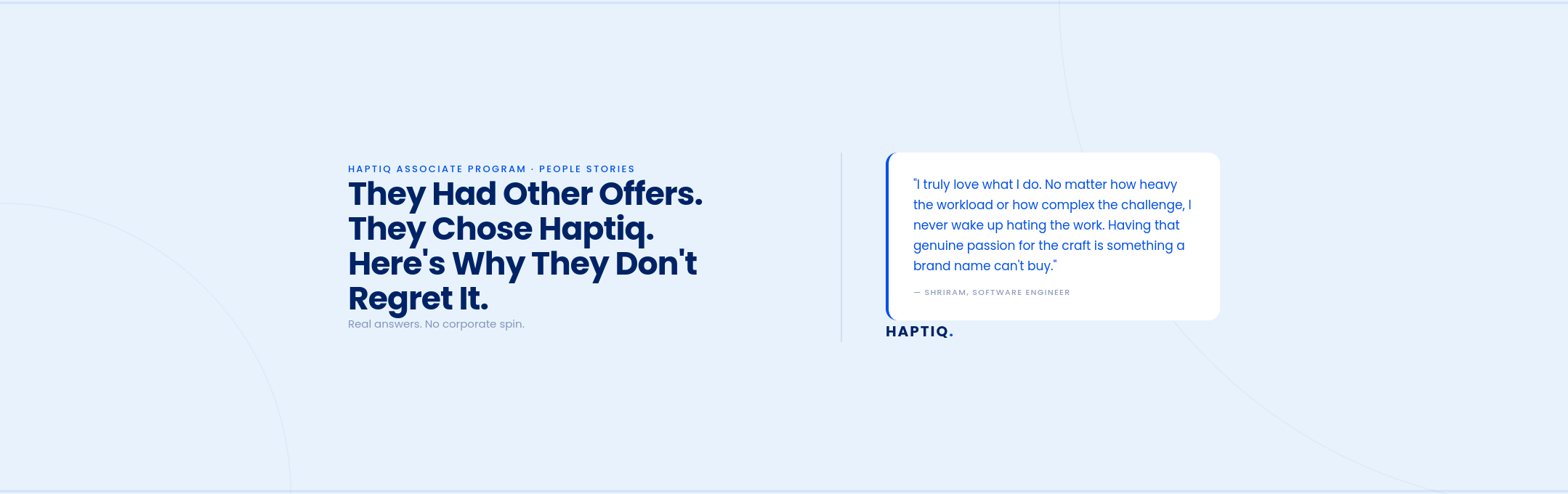
"Many of my peers went to well-known companies, and while we're all busy with our respective careers, I noticed one distinct advantage I have: I truly love what I do. No matter how heavy the workload or how complex the challenge, I never wake up hating the work. Having that genuine passion for the craft is something a brand name can't buy."
— Shriram, on peers who went to big-name firms
Applications for the Haptiq Associate Program are now open.
Think you're ready? Apply here →



.png)

.png)

.png)
.png)





.png)



.png)

.png)
.png)


.svg)
.png)

.png)
.png)
.png)

.png)



.png)




.png)



.png)