Table of Contents
- Introduction
- The Anatomy of Swivel-Chair Operations and SaaS Sprawl
- The Cognitive Toll: Context Switching and Attention Residue
- Quantifying the Productivity Hemorrhage
- The Hidden Cost of Human Error in Manual Data Entry
- How Haptiq Solves Swivel-Chair Fragmentation
- Enterprise Operations Platforms vs. Legacy Systems of Record
- Conclusion
- Frequently Asked Questions
Introduction
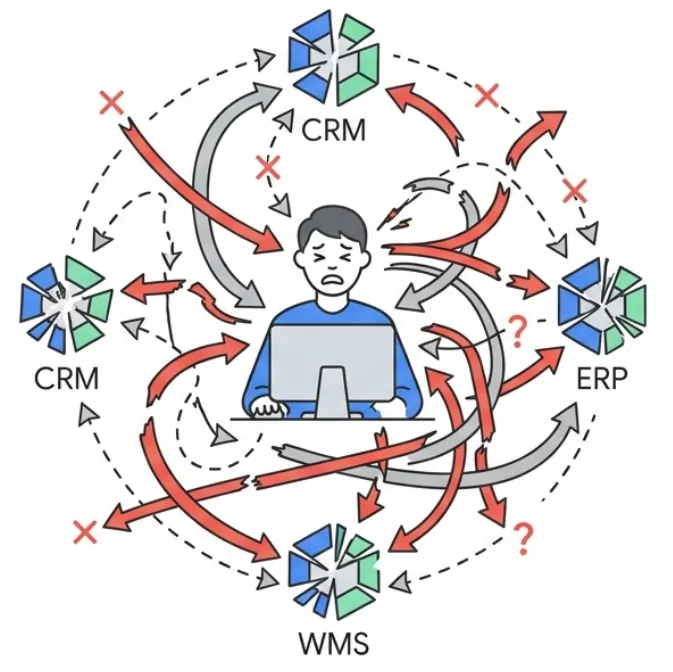
Haptiq's Orion platform eliminates the operational drift and margin drain caused by manual data transfers, transforming disjointed software-as-a-service (SaaS) stacks into a single, real-time execution layer. In modern enterprises, the proliferation of specialized software has created a profound operational paradox: organizations possess more data than ever, yet their execution speed is steadily declining. As teams navigate a deeply fragmented landscape of disconnected tools, employees are increasingly forced into "swivel-chair" operations—the manual act of transferring data, context, and statuses between isolated systems to keep core workflows moving.
When knowledge workers must act as human application programming interfaces (APIs), the organization suffers compounding losses in productivity, data accuracy, and ultimately, earnings before interest, taxes, depreciation, and amortization (EBITDA). This hidden operational debt accumulates quietly, appearing on the balance sheet not as a distinct line item, but as bloated headcount, missed service-level agreements (SLAs), and diminished margins.
This exhaustive research report quantifies the hidden financial and cognitive costs of swivel-chair operations. It examines how continuous context switching, manual data entry, and fragmented operational visibility act as silent margin killers. Most importantly, it outlines how replacing these manual workarounds with event-driven orchestration creates durable, scalable operational flow, demonstrating exactly how unified execution platforms rewire the modern enterprise.
The Anatomy of Swivel-Chair Operations and SaaS Sprawl
Swivel-chair integration refers to the highly inefficient practice of relying on human operators to bridge the gap between disconnected software applications. In this model, an employee physically or digitally "swivels" from one interface to another—highlighting a customer address in a customer relationship management (CRM) tool, copying it, and pasting it into an enterprise resource planning (ERP) system or billing platform. Rather than systems communicating natively, the organization pays skilled professionals to act as the sole data conduit between islands of information.
The scale of this fragmentation has reached unprecedented levels. Data indicates that the average enterprise now relies on approximately 106 distinct SaaS applications to manage its daily operations, a figure that remains exceptionally high despite minor year-over-year consolidation efforts. Furthermore, 95% of Fortune 500 companies rely on SaaS for their core operations, and the average organization uses more than 370 individual SaaS applications across its broader, decentralized environment. While these best-in-class tools offer specialized functionality for individual departments, they rarely share contextual awareness. Consequently, business units adopt new tools faster than IT can govern them, driving a massive shadow IT footprint and creating a web of disconnected operations.
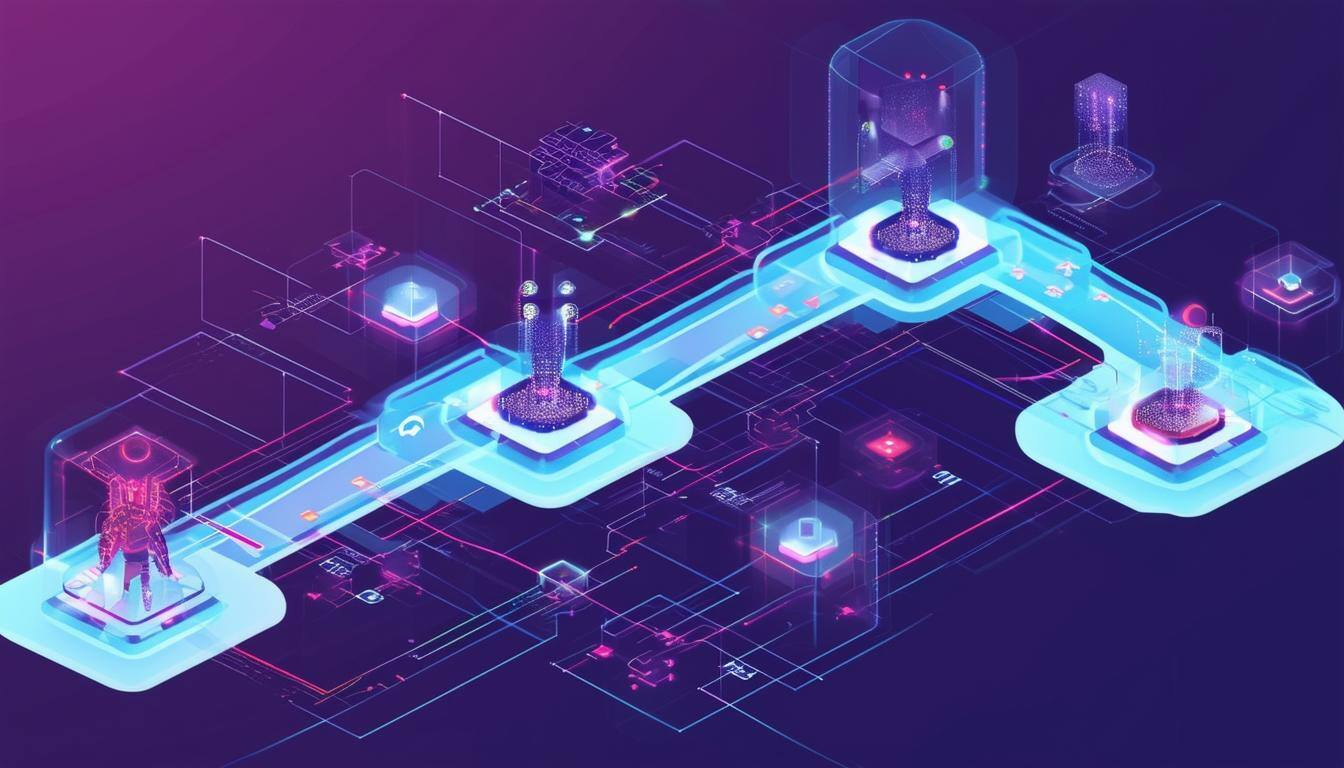
From Fragmentation to Orchestration
Manual Flow
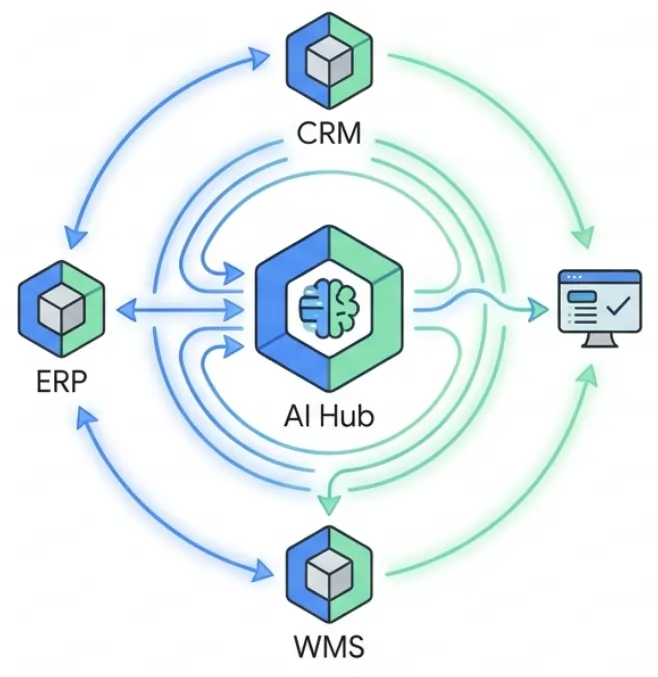
Automated Flow
The inefficiency of this model is universally recognized, prompting large-scale modernization efforts not just in commercial enterprises, but across the highest levels of government and military operations. The U.S. Department of Defense (DOD), for example, has actively identified swivel-chair analysis as a critical operational vulnerability that impacts mission effectiveness. To achieve "decision dominance," military operations are urgently transitioning toward Combined Joint All-Domain Command and Control (CJADC2) architectures, explicitly aiming to replace manual, swivel-chair data entry with integrated, real-time data fabrics that synthesize information from air, land, sea, and cyber domains. When an analyst must receive inputs and manually enter data across different defense systems, the resulting latency creates target acquisition delays that adversaries can exploit.
This exact architectural crisis mirrors the supply chain and procurement challenges faced by private equity-backed manufacturing, logistics, and retail firms. When a supply chain manager must swivel between a warehouse management system (WMS) and a transportation management system (TMS) to diagnose a delayed shipment, the resulting decision latency creates cascading SLAs failures.
The Cognitive Toll: Context Switching and Attention Residue
The financial cost of swivel-chair operations is inextricably linked to the severe cognitive toll it extracts from the workforce. The corporate assumption that employees can seamlessly bounce between a CRM interface, a billing platform, and an inventory database without friction is scientifically flawed.
Decades of research in human-computer interaction reveal that continuous context switching fundamentally degrades the human brain's ability to process information efficiently. According to extensive longitudinal studies conducted by Dr. Gloria Mark at the University of California, Irvine, the average attention span of a worker on any single screen was roughly two and a half minutes in 2004. By 2012, that duration had shrunk to 75 seconds. Today, the average time a user spends on a single screen before switching contexts has plummeted to a mere 47 seconds, with a median of just 40 seconds.
More critically, when an employee is interrupted by a notification or forced to switch contexts—such as toggling to a different application to hunt for missing operational data—it takes an average of 23 minutes and 15 seconds to fully regain deep focus on the original task. During this recovery period, individuals typically drift through two or three unrelated tasks before finding their way back to their primary objective, heavily diluting their work quality and increasing stress levels.
This friction is exacerbated by a well-documented psychological phenomenon known as "attention residue." Identified by Dr. Sophie Leroy at the University of Washington Bothell, attention residue occurs when an individual transitions from Task A to Task B, but a portion of their cognitive capacity remains anchored to the unfinished Task A. In a swivel-chair environment where an employee must suspend an ongoing customer interaction to query a disconnected legacy system, their brain holds multiple incomplete tasks in its working memory. Because the brain struggles to let go of unfinished tasks, employees perform the interrupting task with a reduced cognitive capacity, significantly elevating the risk of errors and decreasing overall throughput. The neurological effort required to constantly "erase and rewrite" the internal mental whiteboard leads to rapid burnout, elevated cortisol levels, and an erosion of job satisfaction.
Quantifying the Productivity Hemorrhage
When workflow continuity breaks down across fragmented applications, the hidden costs cascade directly into the organization's profit and loss statement. The continuous act of context switching is not simply a qualitative annoyance; it is a highly measurable productivity killer that artificially constrains enterprise capacity.
Quantitative data indicates that the mental blocks, re-orientation periods, and operational overhead required by constant toggling can consume up to 40% of an employee's productive time. Computer scientist Gerald Weinberg's rule of multitasking asserts that each simultaneously juggled task reduces an individual's productivity power by an additional 20%, meaning an employee balancing five fragmented tasks loses up to 80% of their potential throughput to the sheer friction of context switching. Furthermore, McKinsey research indicates that knowledge workers spend approximately 19% of their total workweek merely searching for and gathering information across siloed systems.
The Financial Impact of the Toggling Tax
Measuring the temporal and financial drain of continuous context switching across SaaS applications.
When operations depend on disconnected systems, these time leaks compound dramatically. A standard 40-hour workweek functionally degrades into a 20-hour productive week as time is swallowed by searching for data, re-entering records, and managing exceptions "off-system". For an enterprise, this toggling tax carries a severe financial penalty. If an average employee's fully loaded cost is $120,000 annually, the productivity dividend of reclaiming just one focused hour per day equates to $15,000 per person, per year. In a standard 20-person operations team, that represents $300,000 of recovered capacity that goes directly to the bottom line without the need to hire a single additional person.
| Operational Friction Metric | Quantified Industry Average | Direct Enterprise Consequence |
|---|---|---|
| SaaS Application Sprawl | 106 apps per enterprise. | Intense data fragmentation, shadow IT, and siloed visibility. |
| Information Gathering | 19% of the workweek. | Delayed decision latency and artificially inflated cycle times. |
| Interruption Recovery | 23 minutes, 15 seconds. | Severe disruption of operational flow and deep analytical work. |
| Context Switching Loss | Up to 40% reduction in output. | The false necessity of artificial headcount expansion to meet demand. |
| Financial Capacity Drain | $15,000 per employee annually. | Direct erosion of EBITDA and suppressed operational leverage. |
Organizations trapped in this efficiency trap frequently attempt to solve throughput issues by hiring more personnel. However, adding headcount to a broken, manual process only scales the friction, resulting in further margin compression.
The Hidden Cost of Human Error in Manual Data Entry
Beyond the staggering loss of time, swivel-chair operations introduce a far more dangerous variable into the enterprise ecosystem: human error. When employees act as the manual bridge between an ERP, a WMS, and a legacy spreadsheet, they are inevitably subjected to cognitive fatigue, distraction, and keystroke errors.
Across modern industries, the baseline error rate for manual data entry typically ranges from 1% to 4%. In high-complexity or highly regulated environments, the rate of error climbs significantly higher. Studies analyzing clinical database maintenance, point-of-care testing, and health record abstraction have found that manual data processing methods generate pooled error rates ranging from 3.7% up to an alarming 6.57%. In one analysis of point-of-care testing data, researchers discovered that staff-entered result flags deviated from the laboratory information system's generated flags in 73.9% of the cases.
The Escalation of Manual Data Errors
While a 1% to 4% error rate might sound negligible in isolation, when applied across thousands of daily enterprise transactions—such as inventory updates, shipping manifests, procurement orders, or compliance filings—it creates a massive cascade of downstream operational debt. Poor data quality costs organizations an average of $12.9 million annually.
These manual errors lead directly to misrouted shipments, inaccurate financial forecasting, delayed accounts receivable, and catastrophic stockouts. The consequences of these mistakes are often highly publicized and financially devastating. In 2018, a manual data entry error at Samsung Securities—often referred to as a "fat finger" blunder—resulted in the firm accidentally issuing 1,000 Samsung Securities shares instead of 1,000 won (KRW) in dividends to its employees, causing massive market disruption and institutional embarrassment. When exceptions like this occur, operations teams must immediately revert to reactive firefighting, pulling them away from strategic tasks and worsening the vicious cycle of context switching and attention residue.
How Haptiq Solves Swivel-Chair Fragmentation
Traditional attempts to solve SaaS fragmentation typically rely on rigid point-to-point integrations or robotic process automation (RPA) bots. However, these legacy approaches merely mimic swivel-chair keystrokes, failing to address the underlying need for intelligent coordination. Haptiq takes an entirely different, AI-native approach to operational orchestration.
Haptiq's Orion platform standardizes operations across portfolio companies and global sites by creating a single operational layer across teams and data sources—so operating partners and enterprise leaders stop rebuilding the same infrastructure at every new facility. It connects fragmented operations into a unified execution layer by consolidating operational data from all sources into a secure Data Cloud.
Instead of waiting for an employee to manually pull a report or toggle between windows, Haptiq's continuous telemetry monitors system states in real time. When a supply chain anomaly, procurement exception, or inventory shortage occurs, Orion does not simply trigger a passive dashboard alert. It utilizes a coordinated constellation of context-aware AI agents to actively orchestrate a response. These agents automatically gather the necessary context from the WMS, check upstream supplier capacity in the ERP, and present a fully formulated, actionable decision to the human operator via the visual Orion Canvas.
For Private Equity firms struggling with the extreme data fragmentation of new acquisitions, Haptiq's Olympus platform manages the full investment lifecycle. It unifies deal management, due diligence, credit monitoring, and portfolio analytics into one connected system, ensuring that operating partners are no longer relying on outdated, backward-looking spreadsheets. Together, Olympus and Orion empower organizations to close the critical gap between data visibility and coordinated action.
Enterprise Operations Platforms vs. Legacy Systems of Record
The persistent endurance of the swivel-chair problem highlights a fundamental misunderstanding in modern enterprise technology architecture: the conflation of "Systems of Record" with "Systems of Action."
Legacy ERPs and specialized departmental SaaS applications are, by design, Systems of Record. They are highly effective at storing structured data, logging completed transactions, and enforcing rigid compliance frameworks. However, they were never architected to coordinate real-time action across dynamic organizational boundaries. When enterprises attempt to use traditional analytics dashboards to drive their operations, they inevitably run into "decision latency"—the costly delay between when a system registers an operational disruption and when a human manually initiates the correct response in a completely different software environment. Insight alone does not drive action; it merely informs the operator that they need to swivel their chair to fix a problem.
Operational orchestration introduces a dedicated System of Action. It does not seek to replace the ERP; rather, it embeds intelligence and workflow automation directly into the execution path, sitting gracefully above existing legacy systems. By sensing real-time operational conditions, guiding decisions, and coordinating execution across the entire value chain, an Enterprise Operations Platform (EOP) allows the enterprise to move away from batch-based, reactive processing toward continuous, predictive flow.
This architectural shift is the definitive key to unlocking true operational lift. By compressing the time it takes to act, expanding throughput, and permanently eliminating manual handoffs, AI-native workflows drive measurable financial performance. This methodology delivers durable EBITDA expansion in months, not years, bypassing the immense implementation risks associated with multi-year, system-of-record replacements.
Conclusion
The reliance on human employees to act as manual data conduits between disconnected SaaS tools is an archaic and financially unsustainable operational model. The "swivel-chair" paradigm quietly drains enterprise margins through severe productivity loss, rampant manual data entry errors, and the heavy cognitive toll of attention residue and context switching. As long as organizations treat workflow fragmentation as an unavoidable cost of doing business, they will continue to suffer from crippling decision latency, inflated operational overhead, and degraded execution speed.
Connecting fragmented portfolio operations and enterprise workflows into a single execution layer gives operating partners and executives real-time visibility and automated workflows from day one. By transitioning from a patchwork of isolated records to an intelligent, orchestrated system of action, businesses can reclaim lost capacity, secure their margins, and permanently transform execution speed into their primary competitive advantage.
Frequently Asked Questions
1. What is "swivel-chair" integration?
It is the highly inefficient practice of relying on human operators to manually transfer data, copy-paste context, and update statuses between disconnected software applications (like a CRM and an ERP) to keep workflows moving.
2. How much productive time is lost to context switching?
Employees can lose up to 40% of their productive time due to the mental blocks, re-orientation periods (often taking 23 minutes to recover deep focus), and overhead required by constant context switching across fragmented applications.
3. What is the average error rate for manual data entry?
The baseline error rate for manual data entry typically ranges from 1% to 4%. However, in high-complexity or highly regulated environments (such as clinical abstraction or logistics), it can climb up to an alarming 6.57%.
4. What is the difference between a System of Record and a System of Action?
Legacy ERPs act as Systems of Record that simply store historical data and log transactions. Conversely, Enterprise Operations Platforms (EOPs) act as Systems of Action that embed intelligence, monitor real-time telemetry, and coordinate autonomous workflows across those legacy systems.








.png)


.png)

.png)
.png)






.svg)


.png)





.png)



.png)
.png)



.png)


.png)
.png)
.png)


.png)









.png)









.png)








.png)