ERP was one of the most important enterprise software categories of the last three decades. It gave organizations a single system of record for finance, HR, procurement, and supply chain — replacing disconnected spreadsheets and departmental databases with a unified transactional backbone. For the problems it was designed to solve, ERP worked.
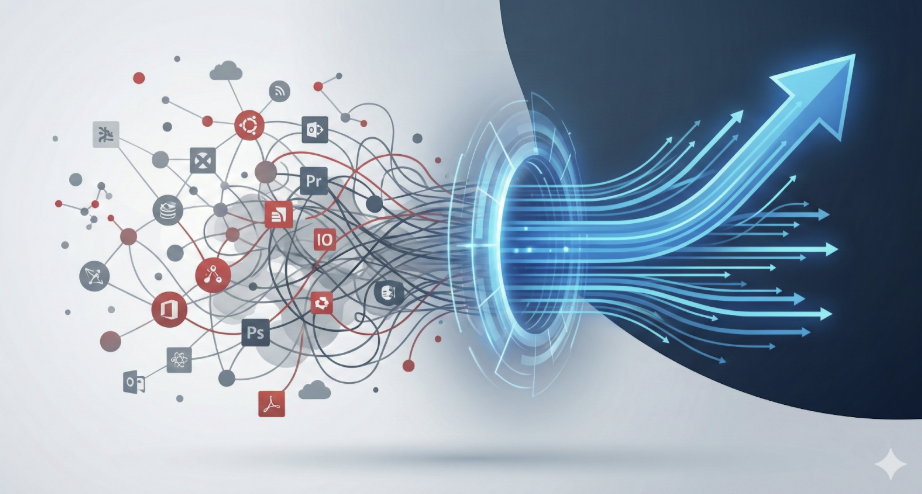
But ERP was designed in a different operational era. It was built to record transactions, consolidate data, and produce reports. It was not built to orchestrate execution across functions in real time, embed decision logic into live workflows, or coordinate governed responses to operational signals the moment they appear. Those are the problems organizations face today — and they are precisely the problems that an Enterprise Operations Platform (EOP) is designed to solve.
Haptiq's Orion platform is an EOP. It does not replace ERP — it operates above and across ERP systems, using their transactional data as input to a governed execution layer that ERP was never designed to provide. This article explains the difference between ERP and EOP, why that difference matters for enterprises, PE-backed companies, governments, institutions, and asset managers, and how to determine which capability your organization is missing.
What ERP is — and what it was designed to do
Enterprise Resource Planning systems were designed to solve a specific problem: siloed departmental data. Before ERP, finance ran on one system, procurement on another, HR on a third, and operations on spreadsheets. Data lived in disconnected places, reconciliation was manual, and getting a consolidated view of the business required significant effort.
ERP solved this by creating a single transactional backbone. Every financial transaction, purchase order, employee record, and inventory movement flows into one system of record. The result is data consolidation, audit trails, and the ability to generate reports across functions that previously couldn't share information.
That remains the core of what ERP does today. Even the most modern cloud ERPs — SAP S/4HANA, Oracle NetSuite, Microsoft Dynamics — are fundamentally systems of record. They capture what happened, store it consistently, and make it available for reporting and compliance.
What ERP does well
- Consolidates financial, HR, procurement, and supply chain data into a single system of record
- Provides audit trails, compliance documentation, and historical reporting across business functions
- Standardizes master data — customers, suppliers, products, cost centers — across the organization
- Supports statutory reporting, period-end close, and regulatory compliance at scale
- Integrates with industry-specific processes through vertical modules and configurations
Where ERP reaches its limits
- ERP records decisions — it doesn't make them. When a supply disruption occurs, ERP shows you the inventory position. It does not evaluate options, trigger a governed response, or coordinate action across procurement, production, and logistics simultaneously.
- ERP processes transactions — it doesn't orchestrate workflows. Cross-functional processes like order-to-cash, procure-to-pay, and exception resolution require coordination across systems and teams that ERP doesn't govern end-to-end.
- ERP produces reports — it doesn't reduce decision latency. The gap between a signal appearing in an ERP dashboard and a coordinated organizational response is unmeasured, unmanaged, and frequently the source of operational and financial leakage.
- ERP standardizes data — it doesn't standardize execution. Having consistent master data doesn't mean workflows, decision thresholds, and exception paths are consistent across sites, business units, or portfolio companies.
- ERP is one system — but operations span many. Most organizations run ERP alongside WMS, TMS, MES, CRM, and QMS. ERP doesn't govern execution across this landscape. It records its own transactions within it.
What an Enterprise Operations Platform is — and what it does differently
An Enterprise Operations Platform (EOP) is a system designed to govern execution rather than record transactions. Where ERP captures what happened, an EOP determines what happens next — connecting operational signals to governed response workflows, embedding decision logic into live processes, and coordinating action across functions and systems in real time.
The distinction is not about replacing ERP. An EOP operates above and across the transactional systems an organization already runs. Haptiq's Orion platform connects to existing ERP, WMS, TMS, MES, CRM, and operational systems through prebuilt connectors — creating a unified operational data layer that surfaces signals in real time, embeds decision logic as governed workflow assets, and coordinates responses across teams and systems the moment a threshold is crossed.
What an EOP does that ERP cannot
- Orchestrates execution across functions in real time. When a signal crosses a threshold, an EOP triggers a structured response workflow automatically, routing to the right decision maker through a governed escalation path.
- Embeds decision logic as governed workflow assets. Approval thresholds, escalation paths, and exception classifications are stored as reusable, versioned assets — not informal practices that vary by manager or site.
- Reduces decision latency systematically. An EOP measures and manages the gap between signal detection and coordinated response — the metric ERP dashboards surface but cannot close.
- Standardizes execution across heterogeneous environments. An EOP gives PE operating partners, multi-site enterprises, and institutions a consistent execution layer across organizations running different underlying systems.
- Creates a reusable pattern library. Each deployment stores workflow templates, KPI definitions, and exception taxonomies as portfolio or enterprise assets — so each new site or acquisition benefits from prior deployments.
EOP vs ERP: the core differences
The simplest way to understand the distinction is through what each system is optimized to answer.
ERP answers: What happened? How much did we spend? What inventory do we have?
An EOP answers: What should we do next? Who needs to act? Has the response been completed?
System type comparison
ERP
System of record
Records what happened — transactions and historical data organized for reporting and compliance.
●
Captures financial, HR, and procurement data
●
Produces reports, audit trails, compliance docs
●
Retrospective — answers "what happened?"
●
Designed for single-entity deployments
●
Requires system replacement to implement
EOP — Haptiq Orion
System of execution
Governs what happens next — connecting signals to governed responses and coordinating action in real time.
●
Orchestrates execution across functions in real time
●
Triggers governed response workflows automatically
●
Forward-looking — answers "what should we do next?"
●
Built for multi-entity, portfolio-scale complexity
●
Connects above existing systems — no replacement needed
Head-to-head comparison
Dimension
ERP
EOP — Haptiq Orion
Primary purpose
Record transactions and consolidate data
Govern and orchestrate execution in real time
Core question
What happened?
What should we do next?
Decision-making
Surfaces data — humans decide outside the system
Embeds decision logic as governed workflow assets
Workflow
Records outputs — exception handling is informal
Governs end-to-end — escalations are structured
Data model
Transactions — invoices, POs, inventory movements
Signals and states — thresholds, exceptions, responses
Deployment
Replaces existing systems — high disruption and cost
Sits above existing systems — no replacement required
Audience
Single-entity — finance, HR, procurement teams
Multi-entity — enterprises, PE, governments, institutions
Why organizations are moving to EOPs — without replacing ERP
Most organizations that deploy Haptiq's Orion platform continue running their existing ERP. SAP, Oracle, NetSuite, Microsoft Dynamics — these systems continue to handle financial consolidation, statutory reporting, HR management, and procurement records. Orion connects to them, extracts the operational signals they contain, and governs the execution responses that ERP surfaces but cannot coordinate.
The trigger for this shift is consistent across industries: operational leaders recognize they have more visibility than ever — but response speed has not improved proportionally. The gap between signal and action remains wide, and no additional ERP module can close it.
For PE operating partners and portfolio companies
ERP standardization across portfolio companies is slow and frequently incomplete within a hold period. Haptiq's Orion platform deploys above existing portco systems to deliver consistent workflows and decision logic without requiring ERP consolidation first.
For multi-site enterprises and manufacturers
Multi-site manufacturers often have standardized ERP but execution varies significantly across plants and regions. Haptiq Orion embeds standard workflow logic at the execution layer — ensuring ERP's consistent data produces consistent operational behavior, not just consistent reporting.
For governments and institutions
Governments and institutional operators need decision governance and audit readiness alongside financial recording. Haptiq's Orion platform provides the governed execution layer that ensures operational decisions are traceable and response times are measurable.
For asset managers and family offices
Asset managers need portfolio-level visibility that ERP — designed for single-entity deployments — cannot provide. Haptiq Olympus surfaces comparable operational metrics across holdings so operating teams can identify execution gaps before they affect returns.
How Haptiq's Orion delivers the EOP layer
Haptiq's Orion platform delivers EOP capability through three integrated components that together address the gap between ERP's transactional backbone and the execution infrastructure operational complexity demands.
How the stack works together
Visibility layer
Haptiq Olympus — portfolio and enterprise visibility
Surfaces comparable performance metrics, decision latency benchmarks, and execution quality across entities, sites, and business units.
Portfolio-level KPIs
Cross-entity benchmarks
Execution quality
Execution layer
Haptiq Orion — Enterprise Operations Platform
Governs what happens next — connecting signals, embedding decision logic, and coordinating governed responses across functions in real time.
Workflow orchestration
Decision logic
Real-time signals
Exception handling
Record layer
ERP — system of record
Continues handling financial consolidation, statutory reporting, HR, and procurement records. Orion connects to ERP — it does not replace it.
Financial records
Compliance reporting
Master data
Operational systems
Existing infrastructure — WMS, TMS, MES, CRM, QMS
Orion connects to all existing operational systems through prebuilt connectors. No system replacement required across any layer.
WMS
TMS
MES
CRM
QMS
When to choose ERP modernization vs when to deploy an EOP
ERP modernization and EOP deployment are not competing decisions — they address different problems. The right question is not "ERP or EOP?" but "what is the operational problem we are trying to solve, and which layer of the stack addresses it?"
Choose ERP modernization when
- Your financial consolidation and compliance reporting infrastructure is fragmented or outdated
- Master data management is inconsistent across systems
- Statutory reporting and regulatory compliance are the primary operational pain points
- You are replacing a genuinely end-of-life legacy system
Deploy an EOP when
- Your ERP is in place but execution is still fragmented — visibility exists but response speed hasn't improved
- Cross-functional workflows are governed informally and inconsistently across sites or entities
- Decision latency is costing the organization — signals appear but coordinated responses are slow
- You manage operations across multiple entities and need comparable execution standards without ERP consolidation first
Many organizations need both — and Haptiq Orion is designed to work alongside whichever ERP is in place. The EOP layer does not compete with the transactional backbone. It completes it.
Bringing it all together
ERP solved the data consolidation problem that defined enterprise operations in the 1990s and 2000s. The Enterprise Operations Platform solves the execution coordination problem that defines enterprise operations now. Organizations that treat ERP modernization as the answer to an execution coordination question will continue to have real-time dashboards and slow response times simultaneously.
Haptiq's Orion platform is the EOP layer that completes the enterprise operational stack — giving operations leaders the infrastructure to respond to signals at the speed the business requires.
Ready to see how Haptiq Orion completes the operational stack your ERP built?
Contact Haptiq
Frequently Asked Questions
What is an Enterprise Operations Platform (EOP)?
An EOP is a system designed to govern operational execution — connecting data from existing systems, embedding decision logic into live workflows, and coordinating governed responses across functions in real time. Haptiq's
Orion platform is an EOP: it deploys above existing ERP, WMS, TMS, MES, and CRM systems to provide the execution layer that transactional systems were not designed to deliver.
Does an EOP replace ERP?
No — an EOP completes ERP, not replaces it. ERP remains the system of record for financial consolidation, compliance reporting, and master data. Haptiq's
Orion platform operates above ERP systems, using their transactional data as input to a governed execution layer that ERP cannot provide.
How is Haptiq's Orion different from an ERP?
ERP records what happened. Haptiq's
Orion platform governs what happens next — triggering response workflows when signals cross thresholds, coordinating execution across functions, and measuring response performance at the portfolio or enterprise level.
Which organizations benefit most from an EOP?
Haptiq's
Orion platform delivers the most impact for organizations managing complexity across multiple entities, sites, or geographies — PE-backed portfolio companies, multi-site manufacturers, governments, institutions, and asset managers or family offices.
What is the difference between ERP, EOP, and RPA?
ERP is a system of record. RPA automates individual tasks. An EOP governs end-to-end cross-functional workflows, embeds decision logic, and coordinates governed responses in real time. Haptiq's
Orion platform operates at a different level of the stack than either ERP or RPA.
What is the difference between EOP and ERP for private equity?
ERP standardization across portcos is multi-year and rarely completes within a hold period. Haptiq's
Orion platform deploys above existing portco systems to deliver standardized workflows without ERP consolidation. Haptiq
Olympus extends this to portfolio-level visibility so operating partners can close execution gaps before they affect returns.





.png)

.png)

.png)
.png)






.png)




.png)

.png)
.png)


.svg)
.png)


.png)
.png)
.png)


.png)






.png)







.png)







.png)