Most acquisitions are won or lost in the 18 months after close. The deal thesis is built on assumptions about what the combined business will look like — synergies, cost savings, revenue opportunities, operational improvements. Realizing those assumptions requires execution. And execution after M&A is harder than almost any other operational context, because you are trying to run two businesses simultaneously while building the systems and workflows to make them one.
The operational challenges that derail post-M&A integration are well documented. Fragmented data across incompatible systems. Duplicated workflows with no clear owner. Teams operating on different processes, KPI definitions, and reporting cadences. Leaders making decisions from incomplete pictures because the data they need lives in a system they can't access yet. By the time these problems surface clearly enough to address, months of value creation time have been consumed.
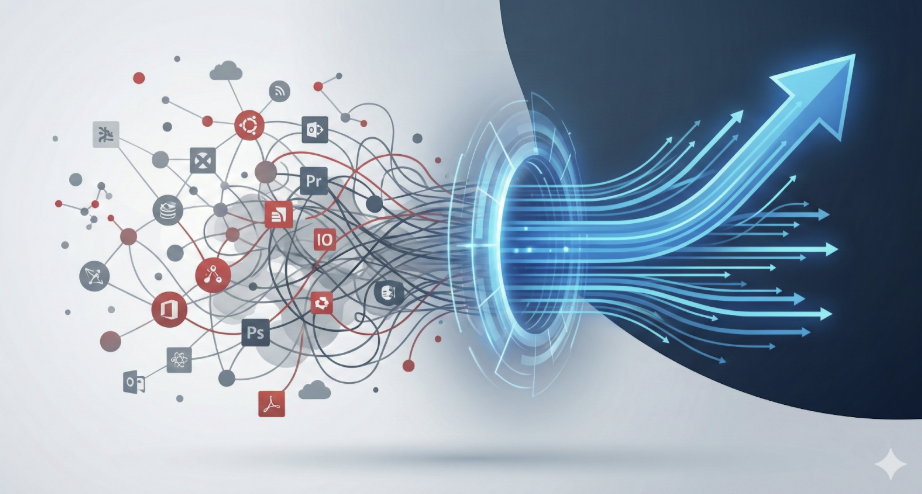
Haptiq's Orion platform was built for exactly this environment. It connects above the fragmented system landscape that every post-M&A organization inherits — unifying data, breaking down operational silos, and giving leadership a single, real-time picture of the combined business without requiring system consolidation to happen first. This article explains why M&A integration stalls operationally and how a unified intelligence layer changes the equation.
Why M&A integration stalls: the six operational failure modes
Post-M&A integration fails operationally for predictable reasons. The same failure modes appear across industries and deal types — which means they are structural, not situational. Understanding them is the prerequisite for addressing them.
1. Data fragmentation makes the combined business invisible
Day one of post-close integration typically means two separate system landscapes: two ERPs, two CRMs, two sets of procurement data, two operational reporting cadences. Leadership needs a consolidated view of the combined business to make integration decisions, but that view doesn't exist until someone builds it. In most organizations, building it means a manual data reconciliation effort that takes weeks and produces a snapshot that's outdated by the time it's complete.
The integration decisions that need to be made in the first 90 days — which supplier relationships to consolidate, which operational processes to standardize, where synergies are actually achievable versus assumed — are all being made from incomplete information. The cost of those misjudgments compounds throughout the integration.
2. Duplicate workflows create confusion and accountability gaps
Two organizations that have been running independently have developed their own ways of doing everything: how purchase orders are approved, how quality deviations are escalated, how customer issues are resolved, how operational exceptions are handled. After close, both sets of workflows continue running in parallel — creating confusion about which process applies, who is accountable for what, and where decisions are being made versus deferred.
This is not a people problem. It's a governance problem. Without a system that embeds clear workflow logic and decision rights for the combined organization, the default is that everyone follows the process they know — which means the combined entity has no consistent operating model even after the legal transaction is complete.
3. Cross-functional coordination breaks down at the seam
The highest-risk operational areas in any integration are the cross-functional processes that span the two legacy organizations — supply chain handoffs, procurement consolidation, shared service transitions, customer-facing operations during the migration period. These processes require coordination across teams that don't have established working relationships, using systems that weren't designed to talk to each other, under timelines that have no tolerance for the normal inefficiency of getting two organizations aligned.
The result is that the integration seam — the boundary between the two legacy operating models — becomes a bottleneck. Escalations that should take hours take days. Exceptions that need cross-functional resolution get stuck waiting for the right person from the right legacy organization to engage. Customers notice before the integration team does.
4. Synergy tracking is manual and optimistic
Integration theses are built on synergy assumptions that were modeled during due diligence with limited data access. Post-close, tracking whether those synergies are materializing — and at what pace — typically relies on manual reporting from the teams responsible for delivering them. That creates an obvious data quality problem: the people reporting synergy progress have an incentive to report favorably, and the leaders receiving those reports don't have an independent data source to validate against.
By the time a synergy assumption is clearly not tracking, the integration is often six to twelve months in — with the gap between the model and reality too large to close within the original timeline.
5. Integration fatigue sets in before value creation begins
Post-M&A integration consumes enormous organizational bandwidth. Finance is closing two sets of books. HR is managing two compensation structures. IT is maintaining two system estates while planning to consolidate them. Operations is running two sets of processes. The people with the deepest institutional knowledge of each legacy business — the ones whose expertise is most essential for making good integration decisions — are the most overloaded.
Integration fatigue is the point at which the organization stops making progress and starts managing the status quo. It typically arrives before the integration is complete, and it is extremely difficult to reverse without an external forcing function.
6. ERP consolidation becomes the integration itself
The most common response to post-M&A system fragmentation is to launch an ERP consolidation program. This is often the right long-term answer — and almost always the wrong short-term priority. ERP consolidation in a post-M&A context takes 18 to 36 months, consumes significant IT and operational capacity, and produces no operational benefit until it is complete. In the meantime, the business runs on fragmented systems, manual reconciliation, and the shadow IT that teams build to fill the gaps.
The operational value creation that the acquisition thesis assumed cannot wait for ERP consolidation to complete. The integration needs an intelligence layer that works above the fragmented system landscape from day one — not a consolidation program that will finish, if it finishes on time, two years from now.
What post-M&A operational integration actually requires
Effective post-M&A operational integration needs to solve three problems simultaneously, and it needs to solve them faster than ERP consolidation allows.
The four INTEGRATION REQUIREMENTS
Unified visibility across fragmented systems
Leadership needs a consolidated operational picture of the combined business from day one — not after a two-year consolidation program. The right approach connects above both system landscapes to surface consistent, real-time metrics without requiring underlying system replacement first.
Consistent execution logic for the combined entity
The combined organization needs a single set of workflows, decision rights, and escalation paths — embedded in a platform rather than documented in a playbook that teams may or may not follow. Consistency has to be enforced by the system, not managed by people.
Independent synergy and integration tracking
Synergy progress needs to be tracked against real operational data — not self-reported by the teams responsible for delivering it. Leadership needs an independent view of where the integration is on track, where it's slipping, and what the downstream impact is before it becomes a quarterly miss.
Speed to operational standard
The longer it takes to establish a consistent operating model for the combined business, the more value creation time is consumed by integration overhead. The integration platform needs to deploy in weeks, not months — and deliver measurable impact within the first 90 days.
How Haptiq addresses post-M&A operational challenges
Haptiq's Orion platform connects above the system landscape of both the acquiring and acquired organization — pulling operational data from each legacy system estate into a single, governed data layer without requiring either system to be replaced or consolidated first. From that unified layer, it surfaces the real-time operational picture that integration leadership needs, embeds the workflow logic for the combined entity, and tracks execution against the integration plan independently.
How the integration layer works
Govern
Unified execution logic for the combined entity
Standard workflows, decision rights, and escalation paths embedded for the combined organization — so execution is consistent from day one regardless of which legacy system each team is working in.
Workflow standardization
Decision governance
Synergy tracking
Unify
Single operational data layer across both system estates
Data from both legacy system landscapes consolidated into one governed, real-time data model. Consistent KPI definitions, reconciled master data, and a single source of truth for the combined business — without system consolidation first.
Real-time consolidation
Master data reconciliation
Audit-ready
Connect
Both legacy system estates — no replacement required
Orion connects to acquiring and acquired organization systems simultaneously through prebuilt integrations. ERP consolidation can proceed on its own timeline — the intelligence layer doesn't wait for it.
Acquirer ERP
Target ERP
CRM
WMS / TMS
Procurement
Post-M&A integration timeline: where Haptiq fits
Integration phases and platform value
Days 1–30
Day one operations
Connect both system estates; establish the unified data layer
Orion connects to both legacy systems immediately post-close. Leadership gains a real-time consolidated view of the combined business before the first integration decision is made. No manual data reconciliation required.
Instant visibility
Baseline KPIs
Days 30–90
Integration design
Embed combined-entity workflow logic; begin synergy tracking
Standard workflows and decision rights for the combined organization embedded in the platform. Synergy tracking begins against real operational data — independently of management self-reporting.
Workflow standardization
Synergy baseline
Months 3–12
Value creation
Drive cross-functional execution; track integration milestones in real time
Cross-functional workflows operating consistently across both legacy organizations. Integration milestone tracking and synergy progress measured against plan — with early warning alerts when execution is slipping before it becomes a miss.
Cross-functional execution
Milestone tracking
Months 12+
Steady state
ERP consolidation proceeds on its own timeline; platform value persists
ERP consolidation can complete at whatever pace makes sense. Orion continues to operate above it — and above whatever new system landscape emerges — without re-implementation. The integration playbook becomes a reusable asset for the next acquisition.
ERP-agnostic
Reusable playbook
Breaking down operational silos after M&A
Operational silos after M&A are not primarily a cultural problem — they are a systems and workflow problem. Teams operate in silos because their systems don't share data in real time, their workflows don't cross organizational boundaries, and there is no common operational language between the two legacy organizations. Culture follows structure. Fix the structure and the silos begin to dissolve.
Haptiq's Orion platform breaks down operational silos by creating a single data layer that both organizations share from day one, embedding cross-functional workflows that cross the legacy boundary by design, and establishing consistent KPI definitions that give leadership a common operational language across the combined entity.
The result is not just better visibility — it is a change in how the combined organization actually operates. Supply chain and procurement decisions that previously required three-day email chains across two organizations get resolved in hours through governed workflows. Quality deviations that previously fell into the gap between two legacy QMS systems get routed, escalated, and resolved through a single exception management process. Finance closes the combined books faster because the data foundation is consistent and reconciled in real time rather than assembled manually at period end.
How to coordinate AI across supply chain, procurement, and finance after M&A
Post-M&A organizations face a specific version of the AI coordination challenge: two separate AI initiatives, two data models, and two sets of system integrations that don't connect. Coordinating AI across supply chain, procurement, and finance in this environment requires a unified data layer first — and a platform architecture that applies AI agents consistently across both legacy organizations rather than running separate models in parallel.
Haptiq's Orion platform delivers this through a constellation of AI agents that operate across the unified data layer — monitoring supply chain performance, procurement spend, and financial metrics simultaneously, surfacing cross-functional signals that no single-domain AI can detect, and coordinating responses across functions in real time. The AI layer doesn't know which legacy system the data came from. It sees the combined business as a single operational entity — which is exactly the picture integration leadership needs.
Integration challenge
Without unified intelligence
With Haptiq Orion
Data visibility
Manual reconciliation; weeks to produce a combined view
Real-time unified picture from day one across both system estates
Workflow consistency
Two parallel process sets; accountability gaps at the seam
Single workflow logic embedded for the combined entity immediately
Synergy tracking
Self-reported by delivery teams; validated quarterly at best
Tracked against real operational data in real time; independent of management reporting
Cross-functional escalation
Email chains across two organizations; days to resolve
Governed workflows crossing legacy boundary; hours to resolve
ERP dependency
Consolidated view waits for ERP consolidation — 18–36 months
Intelligence layer operates above both ERPs; no consolidation required first
"Let me get back to you." The six most expensive words in business. Haptiq gives integration leaders the unified intelligence to act on day one.
Contact Haptiq
Frequently Asked Questions
What are the biggest operational challenges after M&A?
The most consistent post-M&A operational failure modes are data fragmentation across incompatible system landscapes, duplicate workflows with no clear ownership, cross-functional coordination breakdowns at the integration seam, optimistic synergy tracking with no independent validation, and ERP consolidation programs that consume integration bandwidth without delivering near-term operational benefit. Haptiq's
Orion platform addresses all five by connecting above both legacy system estates to deliver a unified data layer, consistent workflow logic, and real-time synergy tracking from day one of post-close integration.
Why does M&A integration stall operationally?
Post-M&A operational integration stalls most often because the combined business is being run on fragmented data, inconsistent workflows, and leadership visibility that depends on manual reconciliation across two legacy system estates. Without a unified intelligence layer, integration decisions are made from incomplete information, synergy assumptions go unvalidated until they've already missed, and the operational seam between the two organizations becomes a persistent bottleneck. Haptiq's
Orion platform eliminates the data fragmentation problem from day one — without waiting for ERP consolidation to complete.
How do you break down operational silos after an acquisition?
Operational silos after M&A are primarily a systems and workflow problem, not a cultural one. The fix is a unified data layer that both legacy organizations share in real time, cross-functional workflows that cross the legacy boundary by design, and consistent KPI definitions that give leadership a common operational language. Haptiq's
Orion platform delivers all three above the existing system landscape — without requiring the underlying systems to be consolidated first.
How do you track synergies after M&A?
Effective synergy tracking requires an independent data source — one that isn't dependent on self-reporting by the teams responsible for delivering the synergies. Haptiq's
Orion platform tracks synergy progress against real operational data from both legacy systems in real time, surfacing gaps between the integration model and actual performance before they compound into quarterly misses.
How do you coordinate AI across supply chain, procurement, and finance after M&A?
Coordinating AI across functions in a post-M&A environment requires a unified data layer first — so AI agents are working from a single, consistent operational picture of the combined business rather than two separate data models. Haptiq's
Orion platform provides this foundation and applies AI agents across supply chain, procurement, and finance simultaneously — surfacing cross-functional signals and coordinating responses in real time regardless of which legacy system the underlying data came from.
Do you need to consolidate ERPs before improving post-M&A operations?
No — and waiting for ERP consolidation is one of the most common reasons post-M&A operational value creation stalls. Haptiq's
Orion platform connects above both legacy ERP systems from day one, delivering a unified operational intelligence layer without requiring either system to be replaced. ERP consolidation can proceed on its own timeline — the integration platform doesn't wait for it, and doesn't need to be re-implemented when it completes.




.png)

.png)

.png)
.png)




.png)




.png)

.png)
.png)


.svg)
.png)


.png)
.png)
.png)


.png)




.png)




.png)




.png)